I once watched a triage bot look alive on a pull request while saying nothing useful.
It left a comment. It set a label. The checks looked calm enough that nobody panicked. Under the hood, every shaped answer the classifier had already produced — the kind with a real type, a score, a choice — had been thrown away by a confidence floor, so the public surface collapsed to unknown. The bot was busy. The triage was empty. That is a worse failure than a loud red check, because executives read “the bot reviewed it” and implementers inherit folklore.
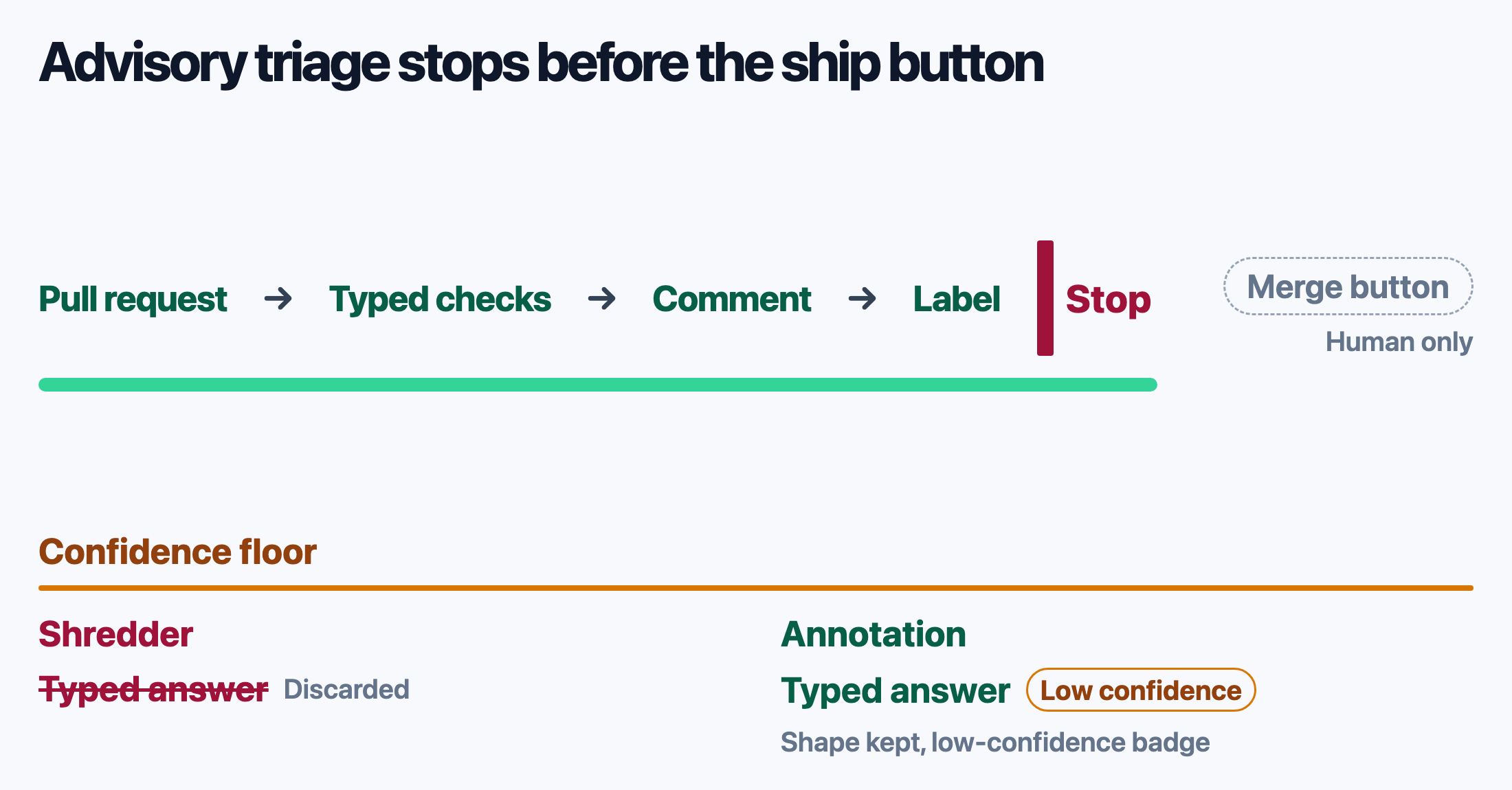
The stealable pattern is advisory PR triage that never owns the merge: typed checks, one marker comment, one triage/* label, a feed note — and nothing that dispatches, merges, or lands from those signals. Phase 1 of the classifier stays fail-open. And when a confidence floor shows up, you do not discard answers that already have a shape. Confident silence is not caution. It is a product bug dressed as humility.
If you get this wrong, you buy either false authority (a comment that feels like a ship decision) or false health (a bot that posts while saying unknown forever). Both train the org to stop reading.
In brief
- A comment on a PR is not merge authority — advisory triage stops before the ship button on purpose.
- Ship a narrow public surface: typed checks, one marker comment, one
triage/*label, a feed note. - Nothing should read that surface to dispatch, merge, or land. Humans keep the button (or a separate, explicitly owned land path does).
- Phase 1 classification should be fail-open — unknown is allowed; silent discard of shapes is not.
- A confidence floor that drops every typed answer to unknown makes the bot look alive while saying nothing. Keep shaped answers even when confidence is low.
- Steal the rule: advisory signals, typed contracts, fail-open early, never floor-away a shape you already had.
Words I use below
- Pull request (PR). A proposed change waiting for review before it joins the main branch — like a change order in an inbox.
- Merge. Accepting that change into the main branch — the ship button. Whoever can merge owns the real risk.
- Advisory comment. A note the bot leaves to help humans decide. It is advice, not permission, and it must not be wired as a gate that lands the change.
- Confidence floor. A cutoff: if the model’s self-reported confidence sits under the line, the system treats the answer as too weak to use. Useful when it demotes mush; dangerous when it discards answers that already have a clear type.
- Fail-open. When the classifier is unsure, it admits unknown and continues without pretending it decided. Phase 1 triage prefers fail-open so a weak model does not become a silent veto.
- Typed answer. A classifier output with a declared shape — a named choice, a score band, a structured slot — not free-text vibes. If you already have a type, throwing it away under a floor is how you manufacture unknown theater.
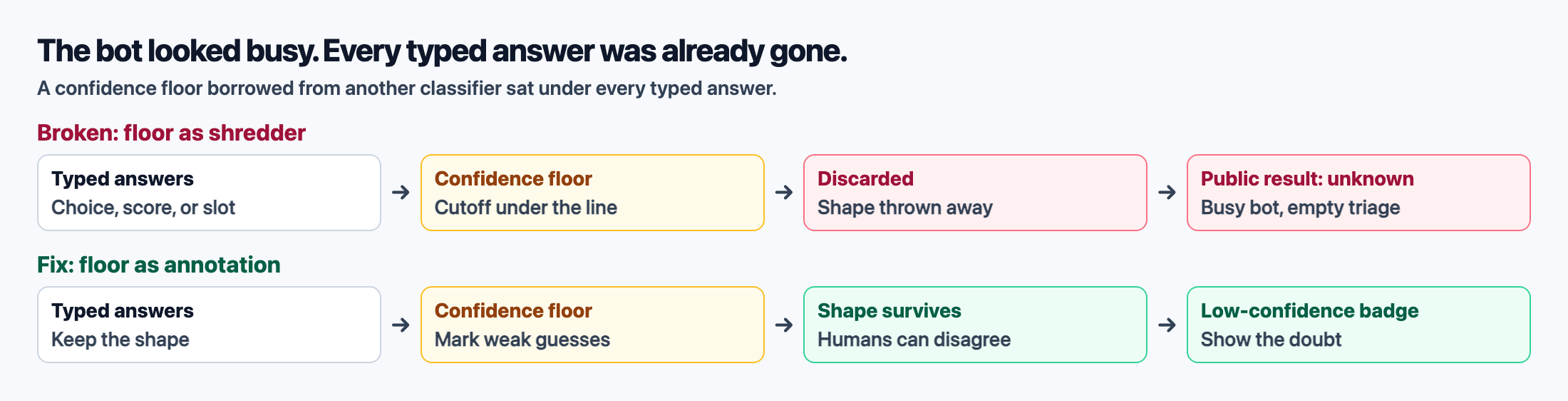
A floor that eats every typed answer leaves a busy bot and an empty triage. Keep the shape. Show the doubt.
Situation
I extend and operate agent and CI paths where bots help humans triage pull requests in public. The advisory-only path is deliberately thin: typed checks, one marker comment, one triage/* label, a short feed note. That is the whole public surface — and nothing in dispatch or land reads those signals to merge. The bot may help in the thread. It must not become the merge button by accident.
Phase 1 of the classifier is fail-open: when it does not know, it says so. The first live run still taught a sharper lesson. A confidence floor borrowed from another classifier sat under the typed outputs. Every shaped answer — structured slots, scores, choices — fell under the line and got discarded. The public result was unknown with cheerful activity around it. The bot looked operated. The triage was empty.
The fix was not “raise the floor until it feels safer.” The fix was stop discarding typed answers under that floor — keep the shape, show the low confidence. Humans can disagree with a weak typed guess. They cannot disagree with a void that pretends to be review.
Why it matters
Executives hear “the bot triaged the PR” and picture leverage. Implementers hear “a comment and a label appeared,” which is narrower, and sometimes emptier. Those are not the same sentence.
Why now: reusable Actions jobs make it cheap to put a voice on every PR. Cheap voices drift toward authority creep (wiring the advisory label into a land job “just for now”) or confident silence (a floor that eats every typed answer so the bot never risks being wrong — and never helps). Teams stop reading comments that always say unknown; leaders still point at the activity as proof the system is live. Dashboards look operated. The inbox stays human-only in practice.
Decision
Prefer advisory-only PR triage with a typed public surface, a fail-open Phase 1 classifier, and a hard rule that shaped answers survive a confidence floor. Keep merge authority human (or on a separate, explicitly owned land path). Offer the triage job as a reusable workflow_call other repos can call — same contract, no private wiring required to steal the shape.
| Approach | What it optimizes | What breaks |
|---|---|---|
| Bot comment that also gates merge | “One system” | Comment becomes ship authority by accident |
| Untyped free-text triage only | Fast demos | No contract; hard to test; hard to reuse |
| Fail-closed Phase 1 on every doubt | Quiet risk theater | Weak model becomes a silent veto |
| Confidence floor discards all typed answers | Never being loudly wrong | Unknown forever; bot looks alive while empty |
| Advisory typed surface + fail-open + keep shapes under the floor | Helpful signal without false authority | Slightly more honesty about low confidence — worth it |
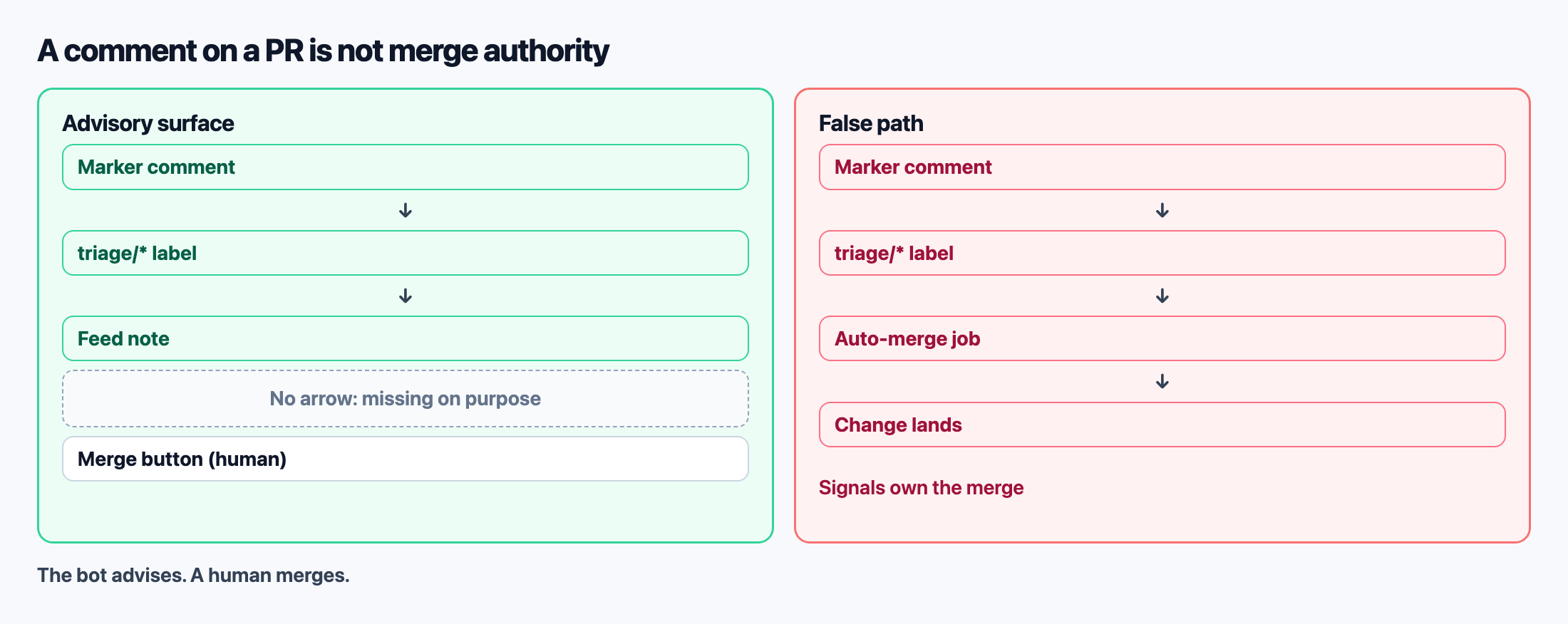
A comment on a PR is not merge authority. The interesting arrow is the one that is missing.
System model
- Human owns the merge button and reads advisory signal as advice.
- Triage bot / job runs typed checks, writes one marker comment, sets one
triage/*label, emits a feed note. - Checks report structured results humans can skim.
- Classifier Phase 1 is fail-open: unknown is first-class, not a discarded shape.
- Confidence floor may annotate low confidence; it must not delete typed answers.
- Land / merge path does not subscribe to the advisory comment, label, or feed note.
- Reusable
workflow_callpackages the same job so other repos can call the contract without copying folklore.
The interesting arrow is the one that is missing: there is no edge from advisory surface → merge. If you draw that edge “temporarily,” you no longer have advisory triage. You have a soft merge button with better marketing.
Implementation detail
You do not need my setup to steal the shape.
- Write the contract first. What types can the classifier emit? What does unknown mean?
- One marker comment per pass — findable, not spam.
- One label family (
triage/*), not overlapping “bot touched this” tags. - Feed note for operators, not for land automation.
- Phase 1 fail-open. Doubt becomes unknown in public, not a hidden drop.
- Confidence floor as annotation, not shredder. Keep typed answers; show low confidence beside them.
- Assert the missing edge. Any job that reads this label or comment to merge gets cut.
- Package as
workflow_callso other repos call the contract instead of forking folklore.
Failure modes
- Authority creep — advisory label becomes a required check for merge. Fix: separate land path; document the missing edge.
- Unknown theater — confidence floor discards every typed answer; bot posts unknown with a smile. Fix: keep shapes; show low confidence.
- Comment spam — five bot voices per PR. Fix: one marker comment contract.
- Fail-closed Phase 1 — weak model vetoes by silence or block. Fix: fail-open unknown.
- Untyped vibes — free text only; cannot test or reuse. Fix: typed answers as the unit of triage.
- Reusable job that secretly owns merge —
workflow_callthat lands when a label appears. Fix: call sites get triage only; land stays elsewhere.
Put it into practice
- Sketch the public surface on one page: checks, one comment, one label, feed note — and explicitly “no land consumer.”
- Add a planted case where the classifier emits a typed answer under the confidence floor; assert the shape still appears.
- Review workflows for any job that reads
triage/*or the marker comment to merge; delete that edge. - Publish the job as
workflow_callwith a typed contract a stranger could follow. - Teach one sentence upstairs: the bot advises; humans merge.
Next in the system
This Pattern sits beside — and does not rewrite — essays on human approval as the merge button and prove-before-floor gate honesty. Those own “who may ship” and “when green is theater.” This one owns a thinner claim: triage in public without becoming the ship button, and never let a confidence floor eat typed answers.
Steal the rule even if your stack differs: advisory signals, typed contracts, fail-open early, keep the shapes you already paid for.