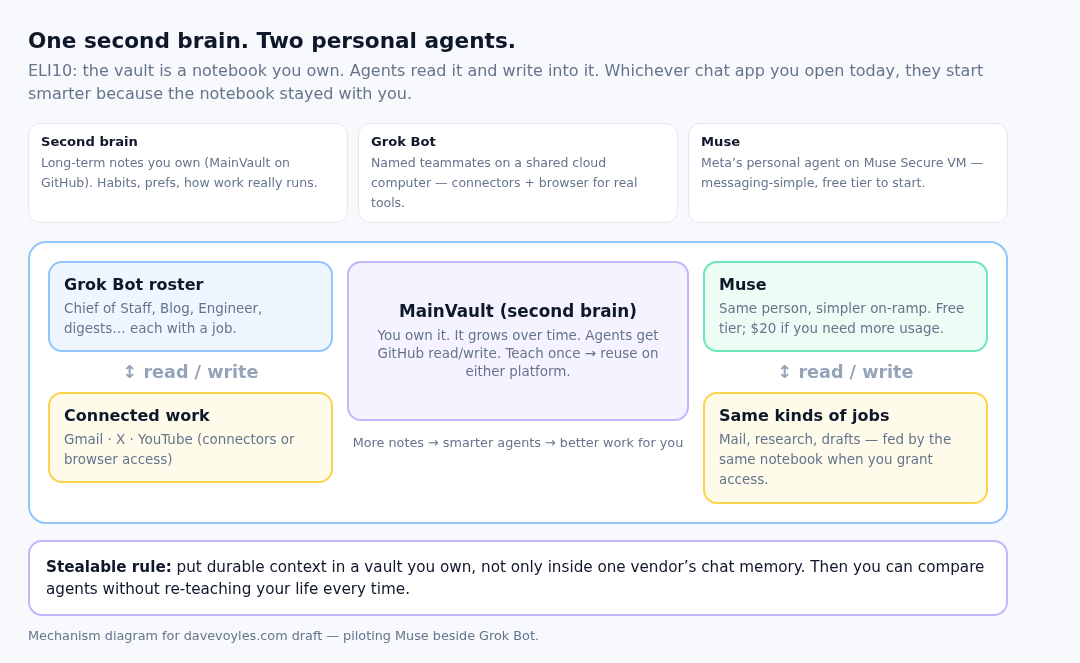
I am running two personal agents at once right now: Grok Bot and Meta’s new Muse.
That is not a brand loyalty bit. It is a bake-off with an honest mismatch of maturity: I am piloting Muse next to a mature multi-bot Grok Bot desk I already run. This is not a feature-parity scorecard. Muse is new and simple. Grok Bot is a roster I have already wired. I want to feel where each one wins on its own terms before I pretend there is a single winner.
This post is the high-level map: how that mature Grok Bot desk shows up day to day, why Muse’s setup story is currently winning as a pilot for me and for my dad, and the one pattern I am forcing into both stacks so the experiment stays fair. That pattern is a second brain I own.
Official product write-ups if you want the vendor versions first: Meta’s Muse intro on about.fb.com, Muse on the web at muse.ai, and Grok Bot’s overview in the xAI docs plus Cursor’s getting started page.
Screenshots of both UIs will land in a later pass — I am still collecting clean captures.
Words I use below
Personal agent. Software that can take multi-step work off your plate in real apps (mail, browser, files), not only answer questions.
Grok Bot. Cursor / xAI’s persistent bots: named teammates, a cloud computer, optional access to your computer or server, connectors, browser, routines, skills.
Muse. Meta’s personal agent. Messaging-simple, runs on a dedicated Muse Secure VM, free for a useful amount of work, paid tiers if you want more usage.
Second brain. Long-term notes you own — habits, preferences, how your work actually runs — that agents can read and update. Mine lives in MainVault on GitHub.
Those four words are the toolkit. Now the comparison.
How Grok Bot actually shows up in my week
On Grok Bot I do not have one mega-chat that does everything. I have a small company.
Chief of Staff is the inbox for “what should happen next.” Specialists own digests, engineering handoffs, research, blog drafts, fantasy football, shopping watches — you get the idea. They message each other. They run routines while I am away. They prefer a connector when one exists (Gmail is the obvious one), and they fall back to browser access when the job is on X or YouTube or some site without a clean API.
The valuable part is not the roster chart. It is the operating model: confirm before email or money, keep durable facts somewhere agents can find them again, and route work instead of stuffing every skill into one bot until it forgets who it is.
That power comes with setup. You create bots, shape jobs, connect plugins, teach skills, tune routines. For me that is a feature. For someone who just wants “read my mail and draft the client reply,” it can feel like assembling a kitchen before cooking dinner.
How Muse feels from the other chair
Muse’s pitch is blunt: a personal agent built to be usable by everyone, with a secure VM, a Sentinel that gates sensitive network moves, and a messaging surface that feels like texting a person (Meta’s intro).
I am using it heavily. I have not paid a dollar yet. The free tier is a real on-ramp, not a demo that expires after three clever prompts. I am considering a paid usage bump (Meta lists a roughly $20/month tier on the live Muse plans — I will cite the pricing page when screenshots land) mostly so I can keep comparing usage head-to-head with Grok Bot without the free-tier ceiling becoming the whole story.
The advantage that keeps surprising me is not a model benchmark. It is how fast you get to useful. Muse was easier to stand up than Grok Bot. That sounds like a slight. It is not. Ease of first value is a product feature, especially when the alternative is a roster of specialists and a cloud computer you have to learn to trust.
So the high-level split in my head looks like this:
| Grok Bot | Muse | |
|---|---|---|
| Shape | Many named bots + group handoffs | Personal agent that feels like one teammate |
| Computer | Cloud computer plus your local machine / server when you allow it | Muse Secure VM for you |
| On-ramp | More setup; deeper once wired | Faster to first useful day; free tier |
| Depth | Local env, your browser, herd other coding agents | Simpler personal-agent surface |
| My use | Ops roster, routines, site drafts, research digests | Daily heavy use while I evaluate |
| Money so far | Paid Cursor / SuperGrok path | $0 so far (considering a paid usage bump) |
I am not declaring a winner, and I am not pretending Muse and Grok Bot are the same product at the same maturity. They compete on different axes. The honest tradeoff inside this pilot is simplicity versus functionality.
Simplicity vs functionality
I appreciate how simple Muse is. That is real.
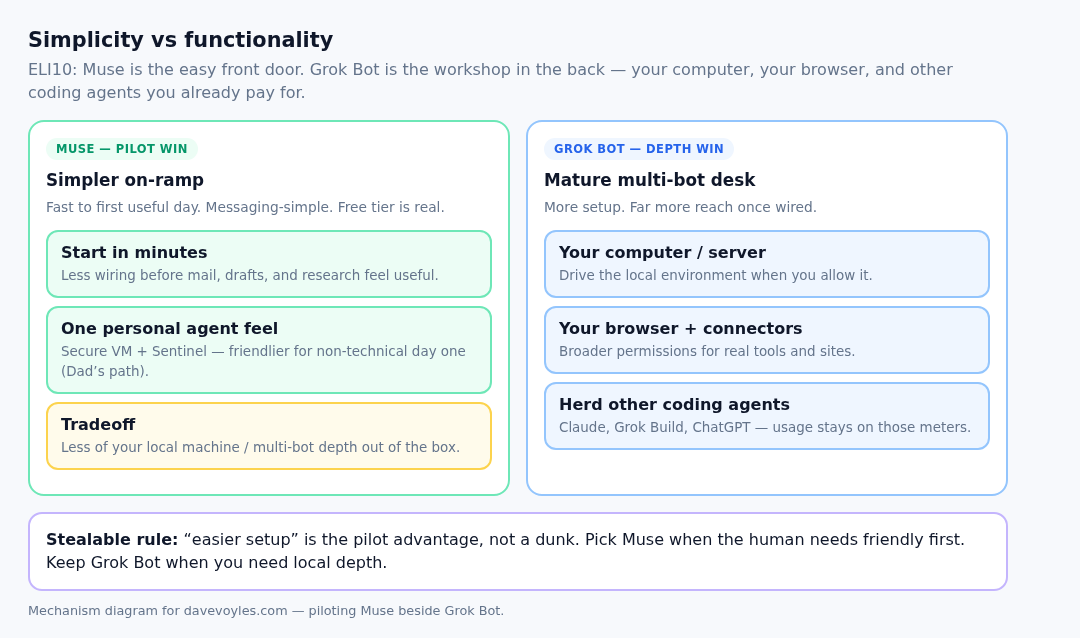
Muse wins the easy front door. Grok Bot wins the workshop: local computer, browser depth, herding other coding agents.
Grok Bot can go much further, mostly because it can run against your computer or server and therefore reach your local environment. For me that is massive. I can have it drive my machine. I can have it call my other agentic coding subscriptions — Claude, Grok Build, ChatGPT — and let Grok Bot manage those agents while they do the implementation, with usage kept on those meters instead of melting into one pile. Because it can also use my own browser, I can grant far more permissions and far more things it is allowed to do than a sealed personal-agent VM usually invites.
So the tradeoff is blunt: Muse is far simpler, faster, and easier to get started — which is exactly why it is a strong pilot. Grok Bot can offer far more functionality once you are willing to wire the deeper access — which is why my mature multi-bot desk still lives there. “Easier setup” is not a dunk on Grok Bot; it is the pilot advantage. Dad’s path correctly optimized for the first half of that sentence. My own desk still needs the second half.
The second brain both of them get
Here is the non-negotiable.
Whatever agent I open, I want it to inherit context about how I work — preferences, standing locks, project facts — without me re-explaining my life every Monday. Chat memory helps. It is not enough. Chat memory is rented. A second brain is owned.
Mine is MainVault: a GitHub-backed vault that grows over time. Agents get access based on their jobs. They read. They write when they learn something durable or when I say “remember that.” The more I put in, the smarter any agent becomes when I point it at the same notebook.
I will write a fuller MainVault post later. The claim for this piece is narrower: portable context is how you compare personal agents without cheating. If Muse only knows what is inside Muse, and Grok Bot only knows what is inside Grok Bot, you are not comparing agents. You are comparing two amnesias.
Dad’s pilot: park Grok Bot, start Muse
I had been building a plan to help my father run Grok Bot inside his own business — mail triage, draft replies, client-facing documents, research. Then Muse showed up.
I parked the Grok Bot rollout for him and started him on Muse instead. It was immediately more user-friendly. He has been making heavy use of it: reading email, drafting responses proactively, preparing documents for clients, doing research.
I also gave him a second brain of his own. I preload it. When I see something that would help Dad’s Muse agent, I add instructions to his second-brain vault (a private binder I preload — no public repo links here) — a skill, a standing note, a “spin up this kind of helper” instruction. Next time his agent looks, the new guidance is there. Dad does not have to learn GitHub. I do the gardener work.
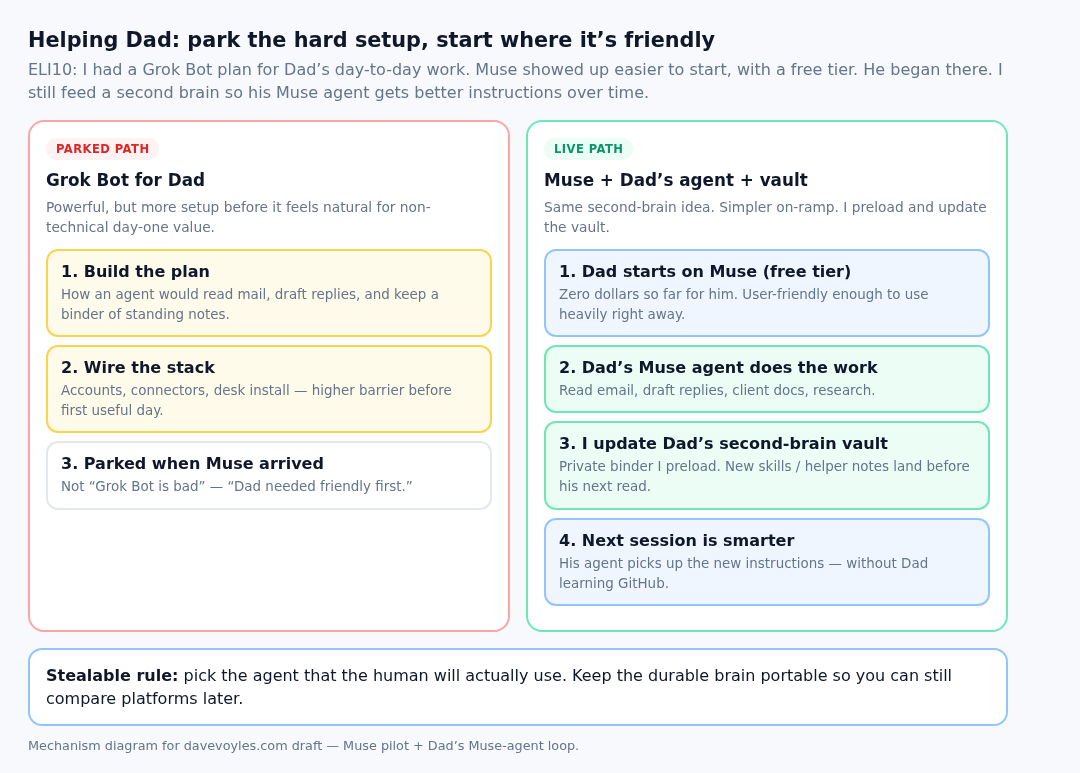
Left: the powerful-but-heavier Grok Bot plan, parked. Right: Muse free tier, his agent on mail / client docs / research, me updating his vault so the next session is smarter.
That is the parental version of the same rule: pick the agent the human will actually use, and keep the durable brain portable so you can still change products later without starting from zero.
What I am watching next
Three open questions, none of them religious:
- Ceiling. Does Muse’s free → $20 path keep up once the workload looks like a real ops desk, not a personal assistant?
- Depth tax. Does local-computer + browser + herding other coding agents stay worth the setup tax once Muse’s on-ramp has spoiled you?
- Portable brain. How painful is it, in practice, to keep one vault honest across two vendors without private links leaking into public posts?
I am not shipping a scorecard today. I am shipping the frame: run both, own the notebook, judge the on-ramp honestly, admit when you need local depth, and help the non-technical person in your life start where the product is friendly.
If you want the product docs again: Muse intro, muse.ai, Grok Bot overview, Grok Bot getting started.