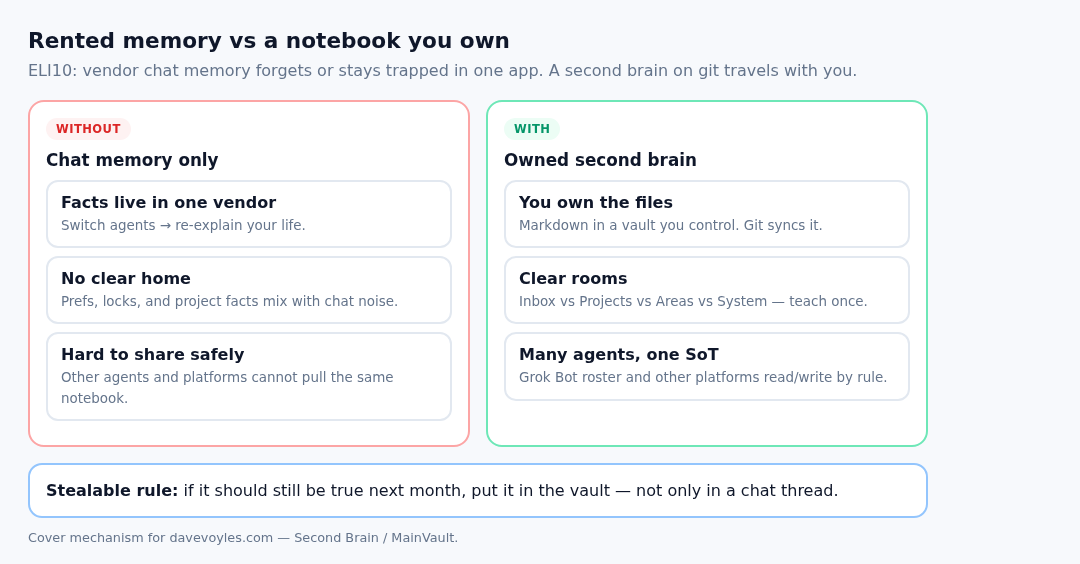
Chat memory is convenient until you change apps.
I run a Grok Bot roster every week — Chief of Staff, specialists, digests, drafts — and I also point other agent platforms at the same durable facts about how I work. If those facts only live inside one vendor’s chat memory, I am not building a system. I am renting amnesia with a nice UI.
So I keep a second brain I own. Mine is called MainVault: a markdown vault, synced with git, treated as shared memory across agents. I already wrote the high-level “owned notebook both stacks get” frame when piloting Muse beside Grok Bot. This post is the mechanism: how that notebook works day to day. No private repo links. The point is the pattern.
Words I use below
Second brain. Long-term notes you own — habits, preferences, standing locks, how work really runs — that agents can read and update.
MainVault. My instance of that idea: an ops-and-project hub in markdown, with Personal context for who I am, not only engineering tickets. Documentation and shared memory — not app code.
Source of truth. The copy everyone must converge on. For MainVault, that is the git remote. A note that is not pushed does not exist to the rest of the roster.
Standing lock. A rule that should stay true across agents (who may write what, confirm-before-send, cover images must be unique, and so on). Those live on vault pages, not only in one chat profile.
Specialist page. A page one bot is allowed to own and update. Everyone else reads it; they do not casually rewrite it.
Those five words are the toolkit. Now the why.
Why a second brain beats chat memory alone
Without an owned notebook, three failures show up fast:
Re-teaching. Every new agent, every new platform, every wiped thread asks me who I am again. Spin up a fresh Blog or research bot and it does not know I preview drafts on the MacBook, or that cover images must stay unique — unless that lived somewhere outside the last chat. I end up pasting the same “how I work” paragraph into yet another empty context window.
Mixed layers. Durable prefs sit next to throwaway chatter. Nobody knows what is still true. “Prefer lighter covers” is a standing lock; “try cover B for this one post” is a one-off. When both only live in chat memory, next week’s agent cannot tell which rule still applies, so it either re-asks or invents the wrong one.
Trapped knowledge. Vendor memory does not travel cleanly when I want Claude on one job, Grok Bot on another, and a coding agent on a third. The bake-off with Muse made that obvious: if each product only remembers inside its own silo, I am not comparing agents — I am comparing two amnesias with different brand names.
An owned second brain flips that. Facts live in files I control. Agents pull before they act. When something should still be true next month, it gets a page — not a hope that the model “remembers.”
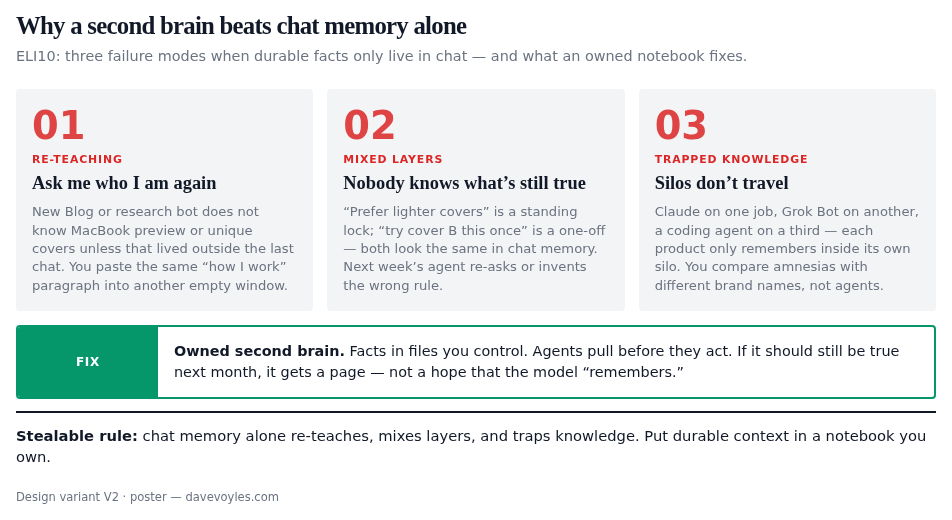
Three failure modes when durable facts only live in chat — re-teaching, mixed layers, trapped knowledge — and the fix: an owned notebook agents can pull.
That does not mean chat memory is useless. It is just a different tier.
RAM vs SSD (short memory vs the notebook)
Agents already have something like RAM: the current thread, a thin profile of prefs, whatever the product keeps hot for this conversation. That layer is perfect for one-offs — “remind me of the draft title we just picked,” “keep going on this PR comment,” “don’t forget I said cover B for the next five minutes.” Fast, local to the chat, cheap to update, and fine if it evaporates when the thread dies or you switch apps.
MainVault is the SSD. Slower to write on purpose, shared across agents and machines, still there next month. Standing locks, who owns which page, how the desk actually works — that is long-term storage. You do not put every scratch thought on the drive, and you do not trust RAM alone for the facts that should outlive the reboot.
The stealable split is simple: hot and disposable stays in short memory; durable and reusable goes in the notebook. Mixing them is how you get “the agent swore it remembered” and a vault that never grew.
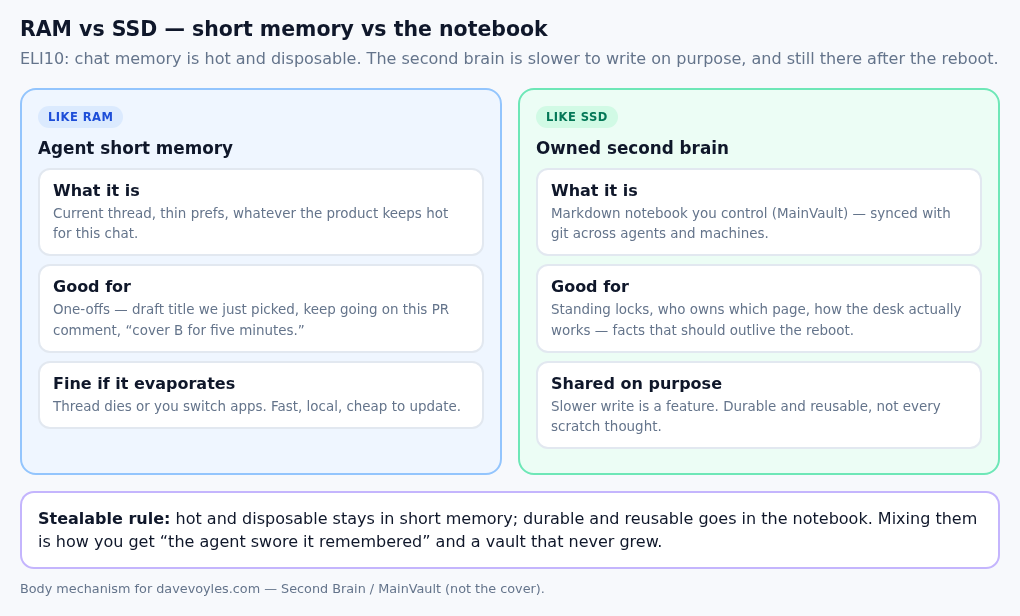
Chat/thread memory is like RAM — fast, local, fine if it evaporates. MainVault is like an SSD — shared, durable, still there next month.
The cover picture for this post is a different before/after (rented chat memory versus a notebook you own). I am not repeating that cover image in the body. Below are more mechanism diagrams: how the folders are laid out, and how agents, GitHub, and two working machines connect.
How MainVault is organized
This vault is an ops and project hub, not a generic “distill the internet into a wiki” project. That scoping matters. It stays useful because it refuses to become a junk drawer with pretty links.
At a high level the rooms are:
| Room | What belongs there |
|---|---|
| Inbox | Raw captures — walk/phone ideas before they earn a home |
| Projects | Active engineering / agent workstreams |
| Areas | Long-running domains — including Personal (who Dave is) and Server Admin |
| Recaps / Weekly work | Time-series notes and ship logs |
| System | Vault standards, indexes, maintenance |
| Hub files | START-HERE, hot, open-items, findings, repo index — how agents find what exists |
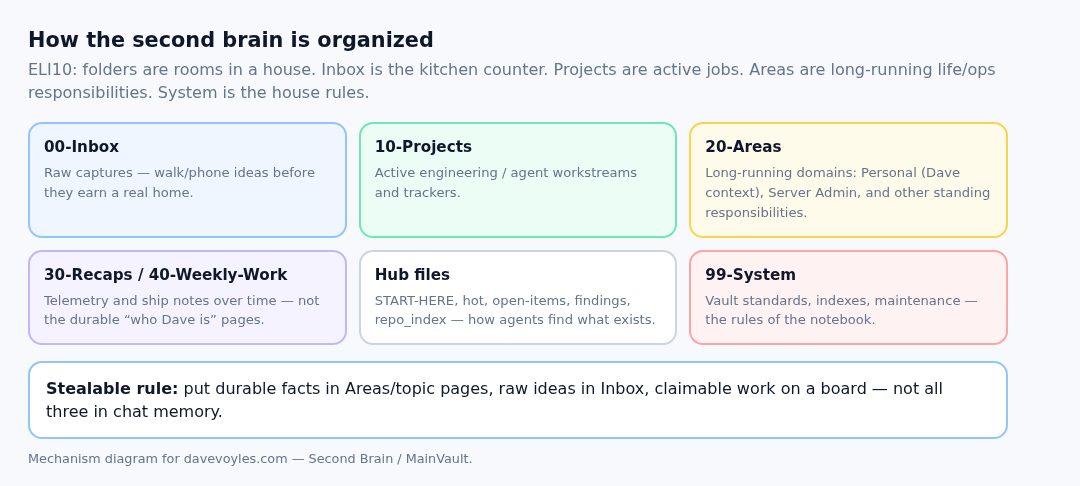
Inbox for raw ideas. Projects for active work. Areas for durable responsibilities. System and hub files for how agents navigate. Stealable rule: do not put all three of “idea,” “durable fact,” and “claimable task” into chat memory.
Personal is a deliberate carve-out. Life context — family, coaching, desk prefs, career loops — lives under Areas so any agent platform can share it. That is not the same as the ops read order. Agents looking for “how does this project list work?” start at START-HERE, then the repo index, then hot / open items / findings, then deep pages. Agents looking for “who is Dave?” start at Personal. Missing catalogue entry? Catalogue first, then deep-dive.
That split keeps the second brain from collapsing into one endless diary.
Day-to-day sync (the boring part that matters)
GitHub is the source of truth. Ordinary durable facts land on main and push. Vault edits are low-stakes and easy to revert, so the workflow prefers “land the fact” over “open a PR and wait.” Rollback via git is fine. Desync across machines is the failure mode auto-push is meant to fix.
Two working clones, on purpose. One on the always-on desk Mac, one on the laptop. A third stale clone was retired so nobody keeps editing a ghost. When a clone is clean, unattended sync is conservative: fast-forward pull if behind, push if ahead, skip if dirty or diverged — never force. In practice the clean copies stay within about fifteen minutes of GitHub. That is a soft claim, not a marketed SLA.
Secrets stay out. Confirm-before email or money is policy in the vault story, not live credentials in the notebook. Placeholders only.
How Grok Bot (and other agents) connect
Grok Bot is the loudest consumer on my desk, but it is not the only one. Agents also keep a thin durable memory of their own for the chat. MainVault is the shared notebook they point at for lasting preferences, locks, and project facts.
Ownership is narrow — default librarian vs specialist shelves. Chief of Staff is the default writer for shared truth: standing locks, cross-agent facts, vault structure (new hubs, renames, who-owns-what). Specialists may push only their own narrow pages — Blog’s pipeline notes, Repo Triage’s build log, study guides, playlist notes, and so on. They do not invent parallel trees. New page needed? Stub it first, then the owner fills it. Critique does not write the vault. Digests stay in that bot’s chat unless something graduates into a standing fact.
Other platforms drink from the same well. Claude, Gemini, Grok, coding agents — when they need durable Dave context or project state, they are pointed at the vault, not asked to invent a parallel memory store. Soft claim only: agents write when they learn something durable or when told to remember.
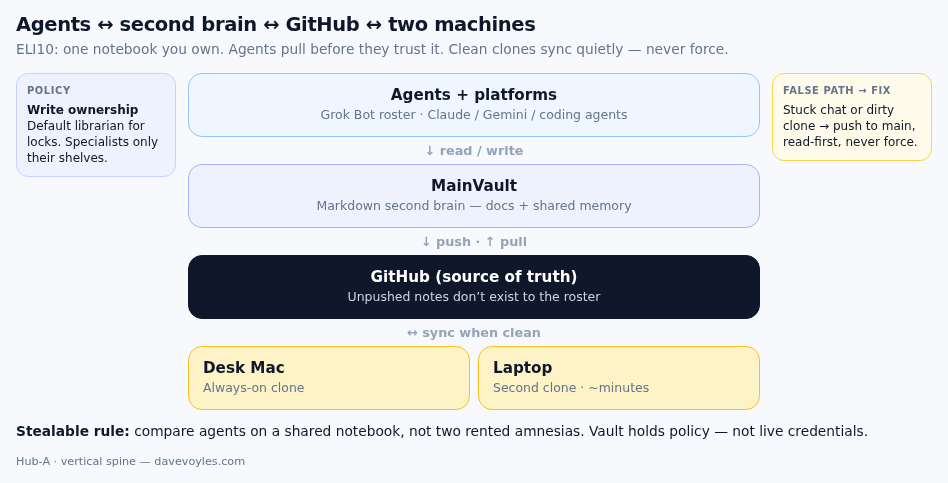
Agents and platforms feed MainVault; GitHub is the source of truth; desk Mac and laptop are the sync edges. False path: fact stuck in one chat or dirty clone. Fix: push to main, read-first, never force.
Connected tools still matter. Gmail, browser sessions, research digests, site drafts — those are jobs. The second brain is the binder those jobs consult so they do not contradict each other.
Advantages I actually feel
Portability. I can compare personal agents without cheating. If Muse only knows Muse-memory and Grok Bot only knows Grok Bot-memory, I am comparing two amnesias. A shared notebook makes the bake-off honest.
Compounding. The more durable facts I file, the less I re-explain. Standing locks survive roster changes.
Safe sharing inside the family of agents. Specialists do not need my entire life pasted into every prompt. They open the topic page.
Human-readable. Markdown in a vault I can open without an API key ceremony. If the agents misbehave, I can still read the notebook.
Separation of concerns. Claimable work stays on a board. Secrets stay in a secret store. The vault holds context and ops truth — not passwords and not every random todo.
What I am still careful about
Public posts never link private vault paths or private GitHub blob URLs. Diagrams and prose have to carry the idea without doxxing the wiring.
Not everything belongs in MainVault. A spike that will die in two days can stay in a chat. A password never goes in. Raw mail and PII do not become vault folklore. A claimable engineering task belongs on the board, with the vault pointing at state when needed.
And ownership rules exist because “everyone writes everywhere” turns a second brain into a conflict log. Narrow writers, shared readers.
The stealable frame
If you only take one thing: treat agent chat memory like RAM and the second brain like an SSD — hot one-offs in the thread, durable facts in a vault you own, with git as the source of truth, clean-clone sync, read-first agents, and one default librarian for shared locks.
Short memory is still useful. It is just a terrible sole home for the facts that should survive the reboot.
I will keep refining MainVault the same way I refine the Grok Bot roster — small locks, clear owners, diagrams when the mechanism matters. The second brain is not a personality cult for notes. It is how the agents stay useful without interviewing me from scratch every Monday.