
I used to want one agent that could do everything.
Write the PR, tidy the calendar, answer Slack, review the diff, remind me about lacrosse pickup — one conversational surface, one “brain,” one place to yell when something was wrong. It felt efficient until the failures started rhyming. Coding work leaned on personal-assistant shortcuts. Calendar noise interrupted engineering focus. A gateway that looked like a helpful front door became a noisy hallway where every request sounded the same, and “the agent is up” — meaning the process is running, the light is on — stopped meaning either job was actually done.
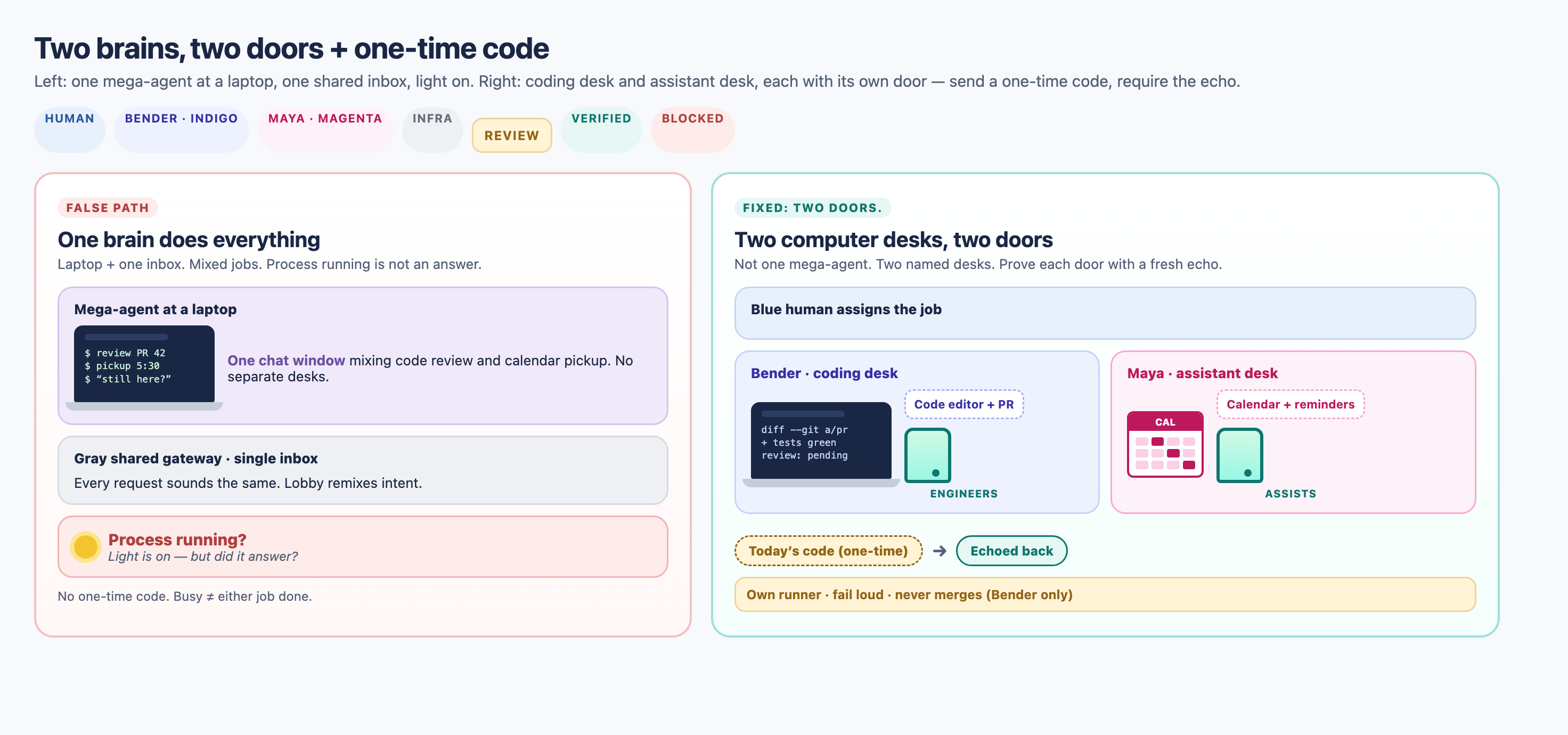
The stealable pattern is not “buy a bigger model.” It is two brains, two jobs: one engineering orchestrator, one personal assistant, on different hosts, with direct doors instead of one mega-gateway, plus capability smokes — short live checks that send each brain a one-time code and require an echo.
That one-time code is a nonce (said “nonse”): think of the restaurant buzzer that only buzzes for your table, or whispering a fresh word through a closed door and needing the person inside to repeat it back. Yesterday’s word does not count. A process that is merely “up” can still ignore you; a correct echo proves this door answered today.
In my fleet those jobs have names. Bender is my engineering agent — Hermes extended and operated on the Mini-class host. Maya is my personal-assistant agent — OpenClaw on the Pro-class host. I named Bender after the Futurama robot people already recognize; the name and the job are mine. I did not invent those platforms — I wire them, name them clearly, and refuse to let one identity pretend it owns both jobs.

Bender — my engineering agent’s name, after the Futurama robot. Character art used under Dave’s draft override; not a licensed still.
If you get this wrong, you buy a mega-agent that is busy and still incoherent. Executives hear “we have agents.” Implementers inherit a single process that cannot fail closed on the right job, because nobody agreed which job it was.
In brief
- One mega-agent optimizes for a single chat surface; two brains optimize for role clarity.
- Name the jobs: engineering orchestrator vs personal assistant.
- Different hosts when work and blast radius differ; direct doors over noisy shared gateways.
- Prove both with capability smokes (live one-time code / nonce echo per door) — “process running” is not enough.
- Engineering review on its own runner, fail loud when credentials are missing, never merge — a separate bot-run lands approved work.
- Steal the rule: split roles, separate doors, smoke what you claim.
Words I use below
- Engineering orchestrator. Coding brain — plans, reviews, repo-facing jobs. Here: Hermes as Bender.
- Personal assistant (PA). Calendar, reminders, life logistics — no merge authority. Here: OpenClaw as Maya.
- Direct door. Clear entry into one brain for one job, not a shared lobby with one voice.
- Gateway. Front process that routes traffic; useful until it becomes the product.
- Capability smoke (or “smoke”). A short live check against one brain’s door: send a fresh one-time code and require that brain to echo it back. “The process is up” (running / light on) is not a smoke — silence or a wrong echo means that door did not answer today.
- Nonce (one-time code). The throwaway value in a smoke — new each run, like a restaurant buzzer number or a secret word for this knock only. Yesterday’s “I’m fine” cannot fake today.
- “Up.” Everyday ops slang for “the process is running.” Useful as a heartbeat; not proof the right brain answered the right job.
- Own runner. Self-hosted Actions runner labeled for the job you mean.
- Fail loud. Missing credentials or a dead door go red (or skip with a named reason).
- Role split. Two named jobs with two identities — not one agent with a longer prompt.
Situation
I extend and operate a small agent fleet on a homelab — roughly the same 20+ Docker-container world I write about elsewhere, plus coding agents and PA surfaces. The temptation was obvious: one stack, one identity, one place to configure tools. Docs drifted. Names drifted. “Hermes” meant engineering on one machine and something softer on another. Review jobs borrowed runner labels that belonged to nobody. A convenience gateway started answering for both jobs badly.
The settling move was boring on purpose. Rename and document so Bender is the Hermes engineering orchestrator on the Mini-class host, and Maya is the OpenClaw personal assistant on the Pro-class host. Park noisy shared gateways. Give each brain a direct door. Add smokes that ping both with a fresh nonce. On the engineering side, land unattended PR review on a distinct runner identity, teach CI to fail loudly when the review credential is missing (so “no secret” and “review passed” never look the same), and keep the rule that the reviewer never merges — a separate bot-run lands approved work.
No private hostnames, Tailscale URLs, or credential values on a public post. The pattern is the point: role split, doors, smoke, fail-loud review without merge authority.
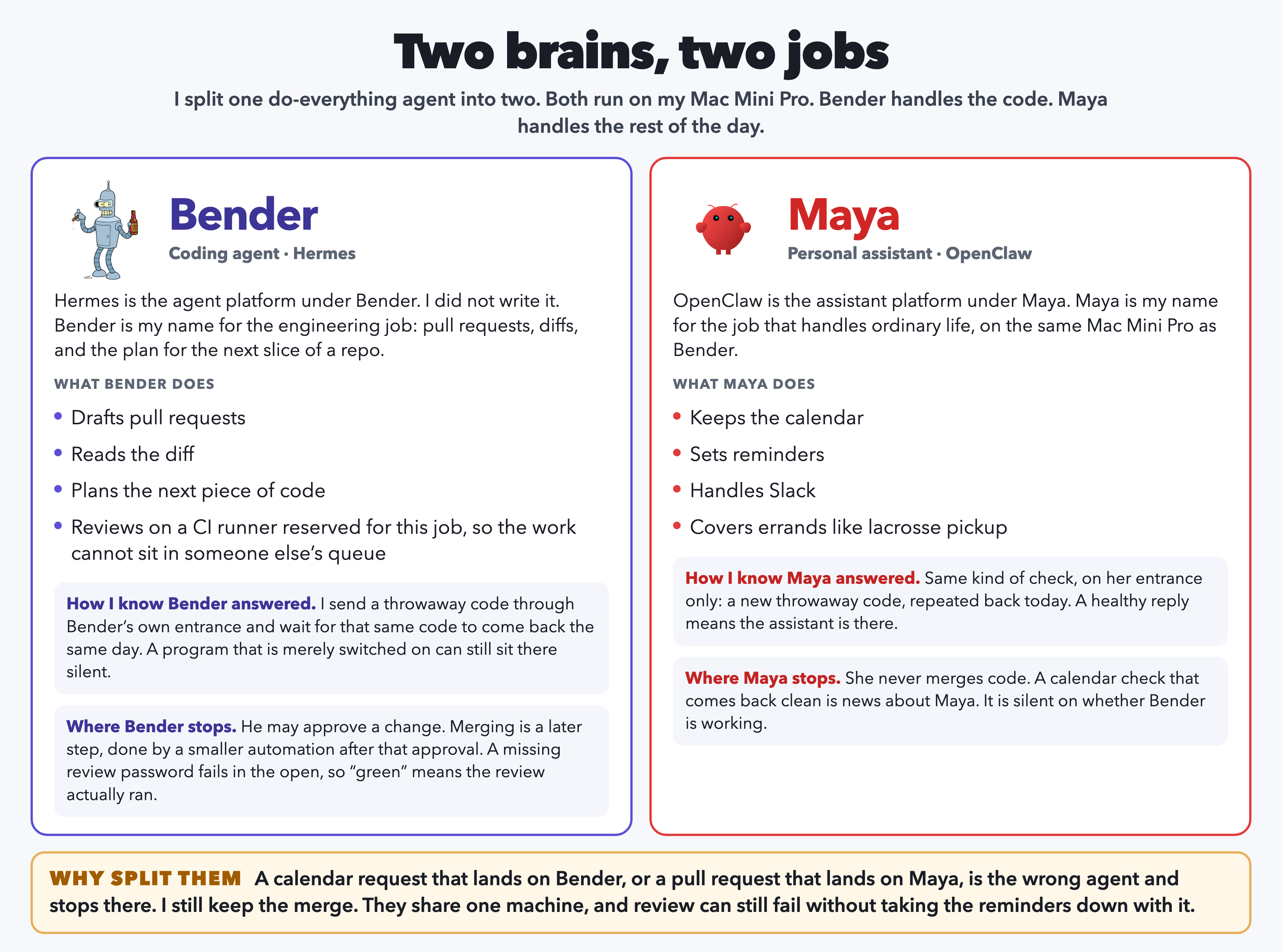
Two jobs on one machine — coding vs the rest of the day — each with its own door and its own one-time check.
Why it matters
Executives hear “one agent OS” and picture leverage. Implementers hear “one process that owns coding and my calendar” and picture thrash. Those are not the same sentence.
Why now: platforms are good enough that the failure mode is no longer “it cannot code” or “it cannot remind.” The failure mode is conflation — the same identity holds merge-adjacent power and household logistics, shares a gateway that remixes intent, and reports “up” (process running) when only one half answered. Separate jobs make separate failures visible. You can fail closed on review credentials without taking down reminders. You can smoke the PA without pretending a green calendar ping proved the engineering door.
The cost of wrong is folklore with a friendly chat UI. Busy is not the same as on the critical path for either job.
Decision
Prefer two named brains with two doors over one mega-agent with a clever prompt. Different hosts when blast radius differs. Smoke both with a fresh nonce. On the engineering brain, unattended review on its own runner, fail loud when credentials are missing, and never let the reviewer own the merge button.
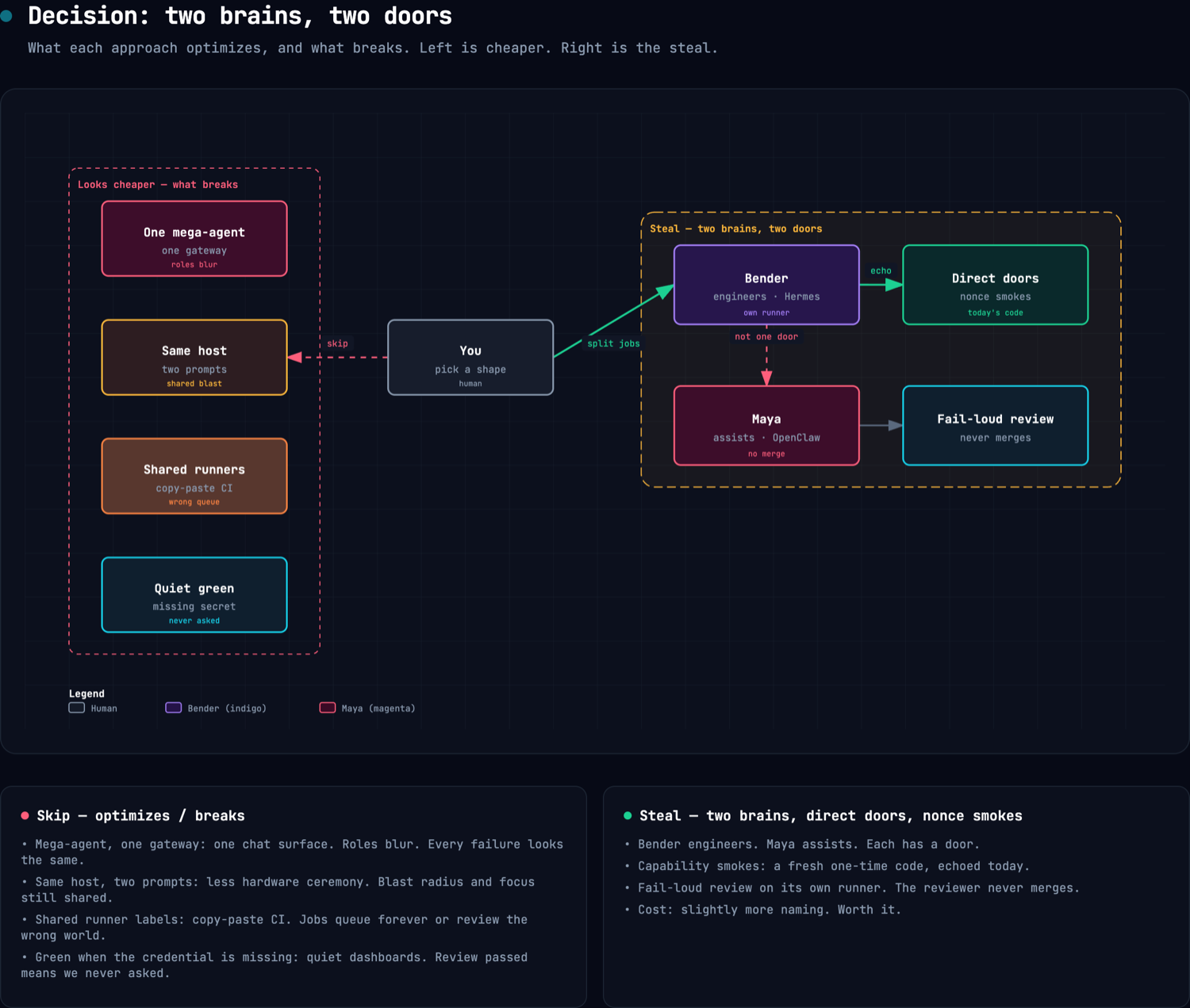
Left looks cheaper. Right is the steal: two named brains, direct doors, nonce smokes, fail-loud review that never merges.
System model
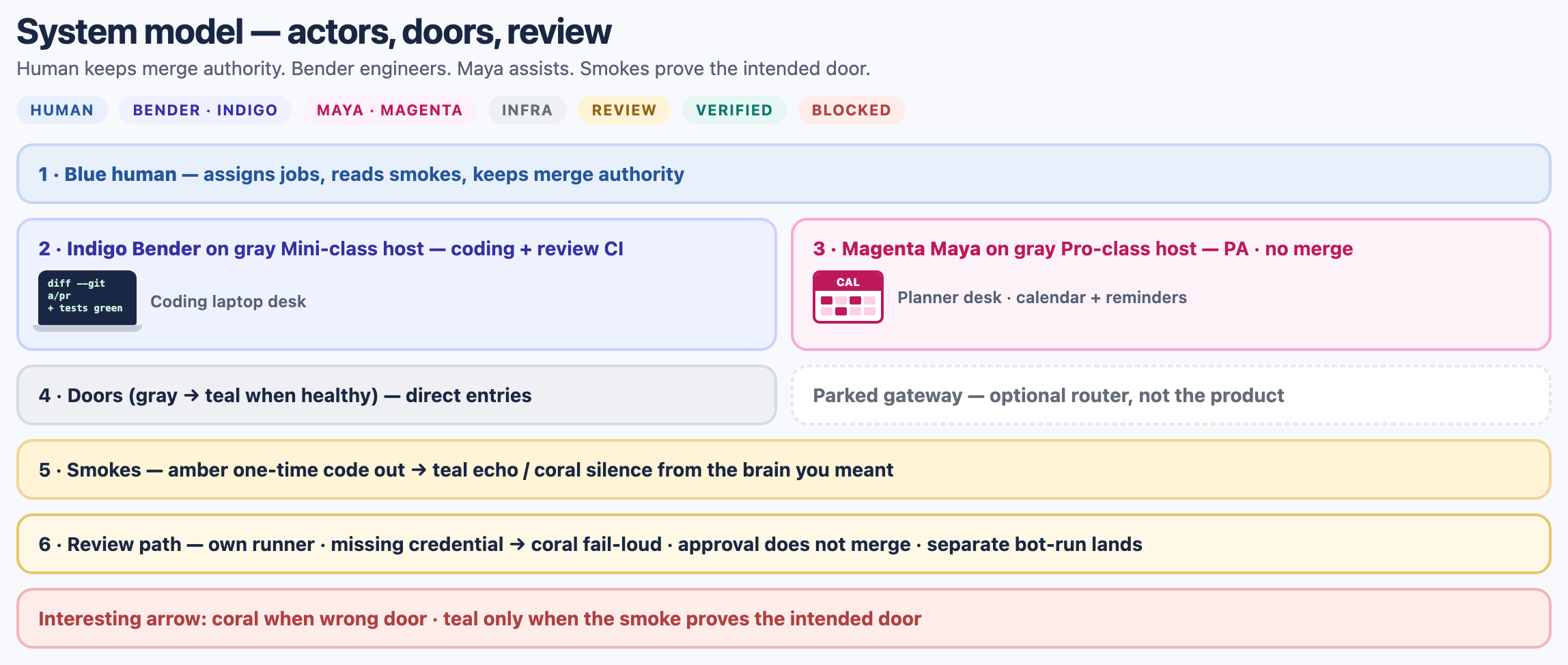
- Human assigns jobs, reads smokes, keeps merge authority.
- Bender — engineering orchestrator on its host — coding work and review CI for that world.
- Maya — PA on its host — does not own merge. Same “agent” family, different jobs so the two brains read at a glance.
- Doors — direct entries; parked gateways optional, not the default product. Healthy doors answer smokes; silent doors fail the check.
- Smokes — fresh nonce from the brain you meant to ping; echo = verified, silence = fail.
- Review path — own runner; missing credential → fail-loud; approval does not merge; separate bot-run lands approved PRs.
The interesting arrow is separation: fail when a request hits the wrong door; pass only when the smoke proves the intended door answered.
Implementation detail
You do not need my fleet names to steal the shape.
- One sentence split. “Brain A engineers. Brain B assists.” Hedge means you do not have a split yet.
- Name identities in docs operators actually read. Platform ≠ role.
- Different hosts when jobs differ. Thrash and blast radius should not be shared by default.
- Direct doors first. A gateway is a router, not a personality — park it when every request exits as one voice.
- One-time-code smokes (nonces) for both brains. Cache-free proof beats “the process is running.”
- Own runner for review. Unmatched labels queue forever and look merely slow.
- Fail loud on missing review credentials. Carve out only named cases; silence is a choice.
- Reviewer never merges. Approval is a signal; a narrower bot-run lands approved work.
- Honest verbs. “Extended and operates” for upstream agent platforms — not “I built the framework.”
Failure modes
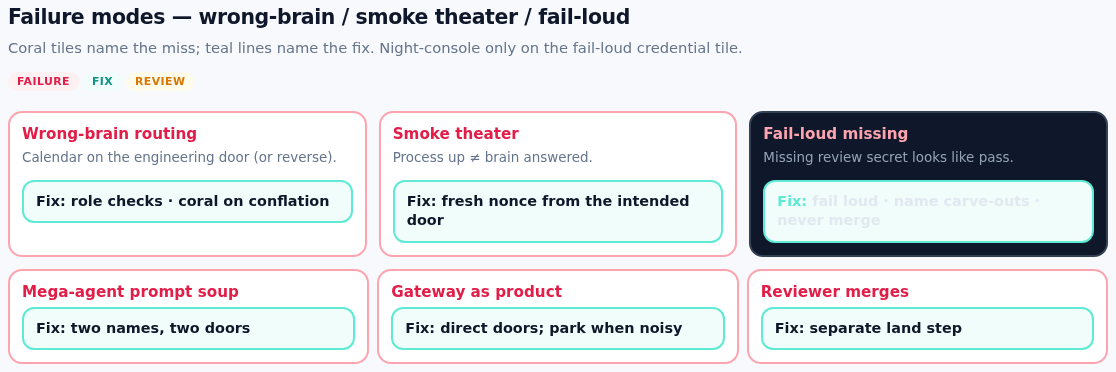
- Mega-agent prompt soup — longer instructions, same conflation. Fix: two names, two doors.
- Gateway as product — one lobby, one voice. Fix: direct doors; park when noisy.
- Same-host thrash — PA noise vs engineering focus. Fix: different hosts when blast radius differs.
- Smoke theater — “process running” ≠ brain answered. Fix: fresh one-time code from the intended door.
- Review green without credentials — missing secret looks like pass. Fix: fail loud; name carve-outs.
- Reviewer merges — approval becomes ship. Fix: separate land step.
- Wrong-brain routing — calendar on the engineering door (or reverse). Fix: role checks; fail loud on conflation.
Put it into practice
- Name your engineering brain and your PA brain in one sentence.
- Put those names in operator docs people actually open.
- Inventory doors: direct vs shared gateway vs park.
- Add a one-time-code smoke per brain; alert on silence, not only process death.
- Map review CI to an online runner label you own.
- Missing review credentials fail loudly — or skip with a named carve-out.
- Confirm the reviewer cannot merge; name what lands approved PRs.
- Run one wrong-brain drill; require a visible fail when the wrong door is hit.
- Operator rule: two jobs, two doors, prove both.
Next in the system
This is the role-split and doors layer — sibling to honest fleet gates and prove-before-floor, not a remake of Mission Control, ops dashboards, or a control-plane home screen. The steal is narrower: stop asking one agent to be your engineer and your chief of staff in the same breath.
If your agents are fluent and your identities are politely lying about which job they own, you still have folklore — just folklore with two chat tabs that were secretly one.
Bottom line: two brains, two jobs — Bender engineers, Maya assists — direct doors, nonce smokes, and review that can fail loud without ever owning the merge button.