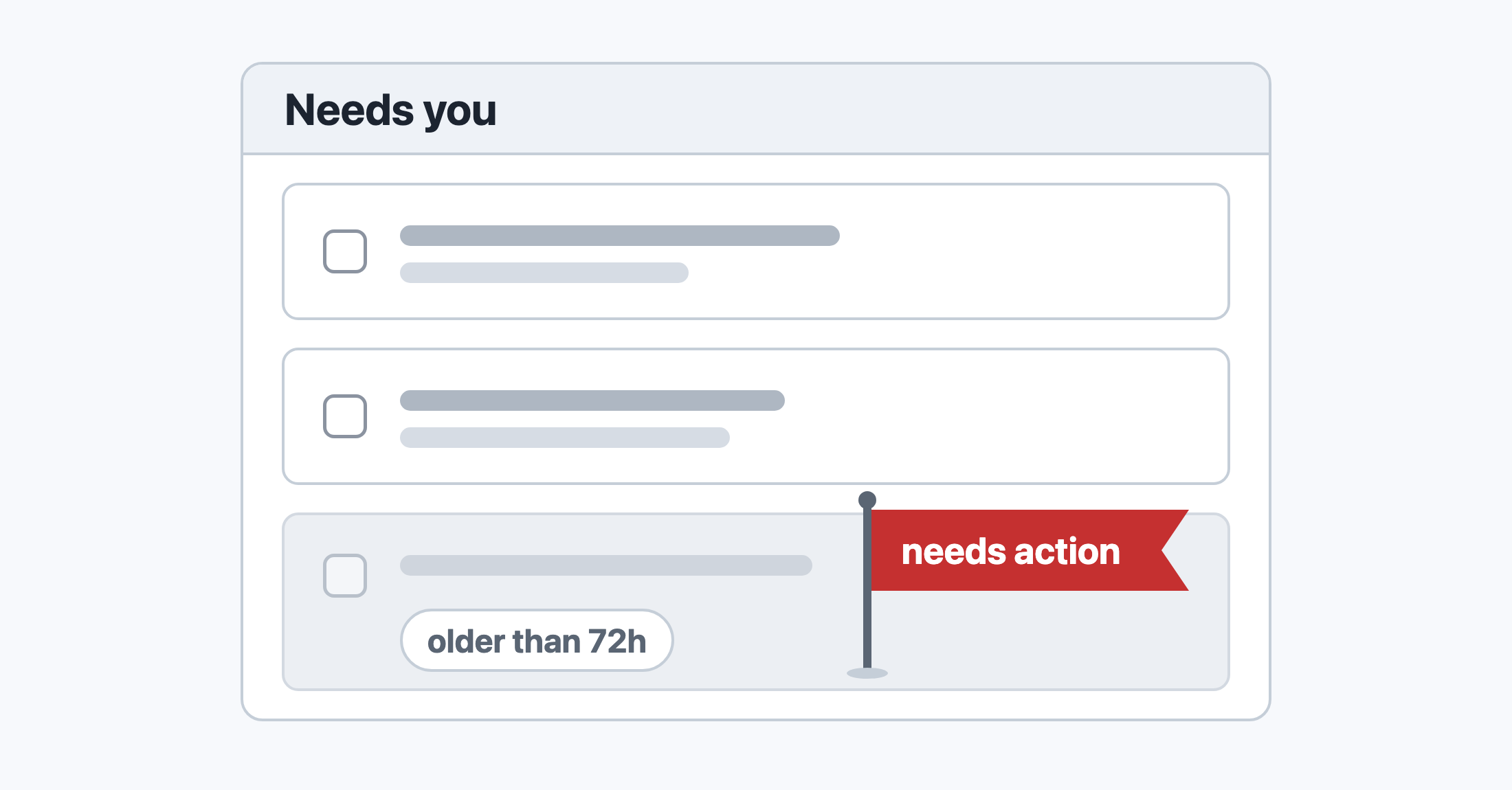
A to-do list where an old card has been muted to gray while a red flag on it is still raised.

Old is not the same as done

One morning my Needs you strip told me I had three things waiting. As far as I could tell, I had zero. That strip sits at the top of a small page that tells me what my coding agents need from me, and the point of it is that I can glance at it over coffee and know whether I have work to do. Two were alarms about nightly test runs that had gone red once and then passed every night since, and the third was a pull request that nobody had touched in days and that the page kept calling stuck. A strip that seems to cry wolf three times before breakfast is a strip you stop reading, which is worse than having no strip at all. ...

November 18, 2026 · Dave Voyles
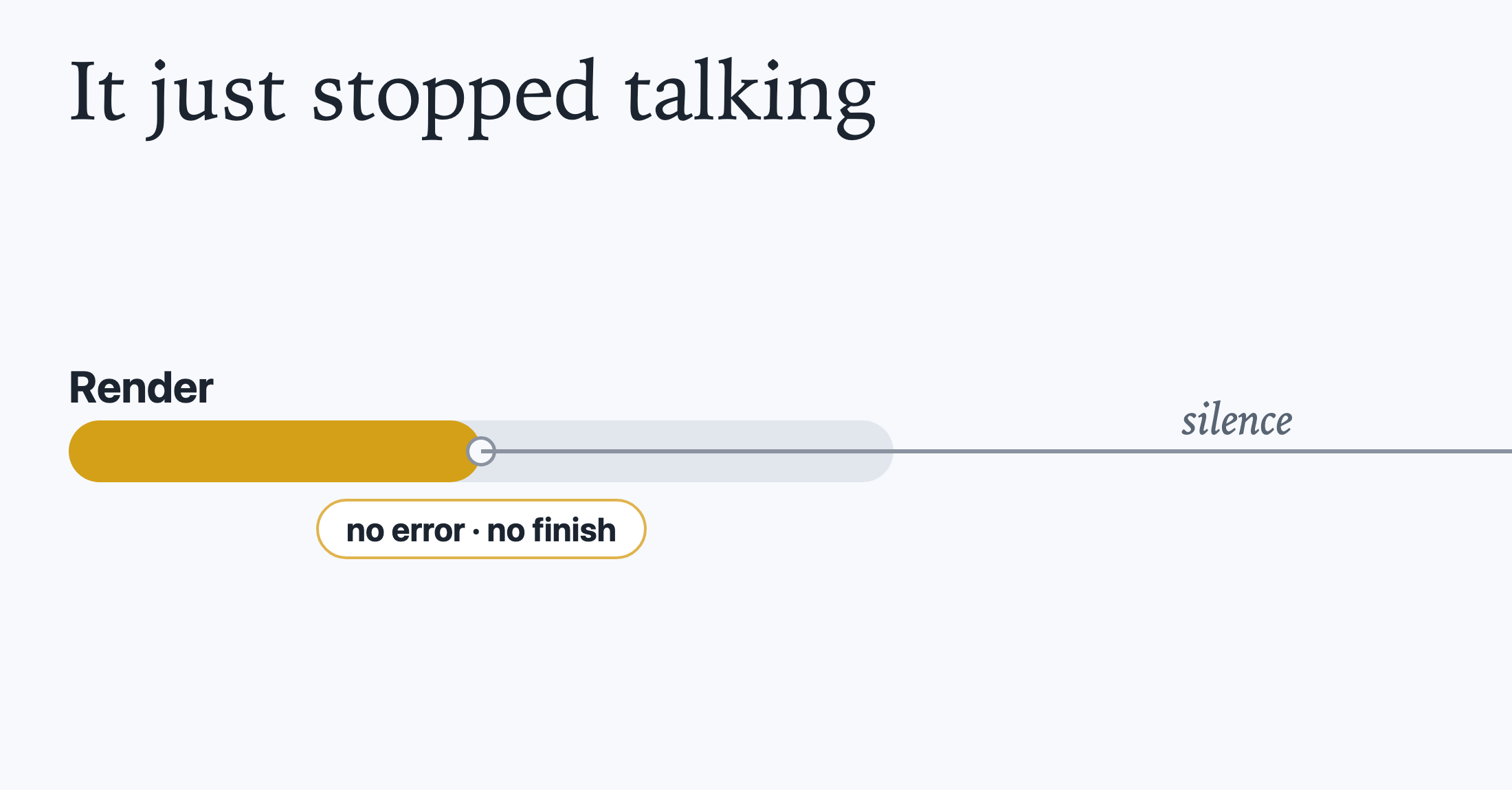
A render progress bar stops partway while a flat line labeled silence runs on off the edge, with a small tag reading no error, no finish.

One render in 25 just stopped talking

Nothing in the log said anything was wrong, and nothing on the screen moved. The render just sat there, forever, like a guest who has finished dinner and decided not to leave. I use a small film and design toolchain to make short product videos, and my coding agents do most of the work on it. Under a loop test, about one render in 25 hung like that. It gave no error and no message, and from the outside I couldn’t tell whether it was thinking hard or had quietly died in its chair. The trigger turned out to be an audio filter left without a length, which its manual says will pad silence indefinitely. Give it a length and the stalls stopped. I still don’t know why the unbounded version stalled only some of the time. That is the most annoying kind of bug there is. The rule I took from this is: every call to an outside tool needs a finish line, and when it crosses that line, it should say why. ...

November 13, 2026 · Dave Voyles
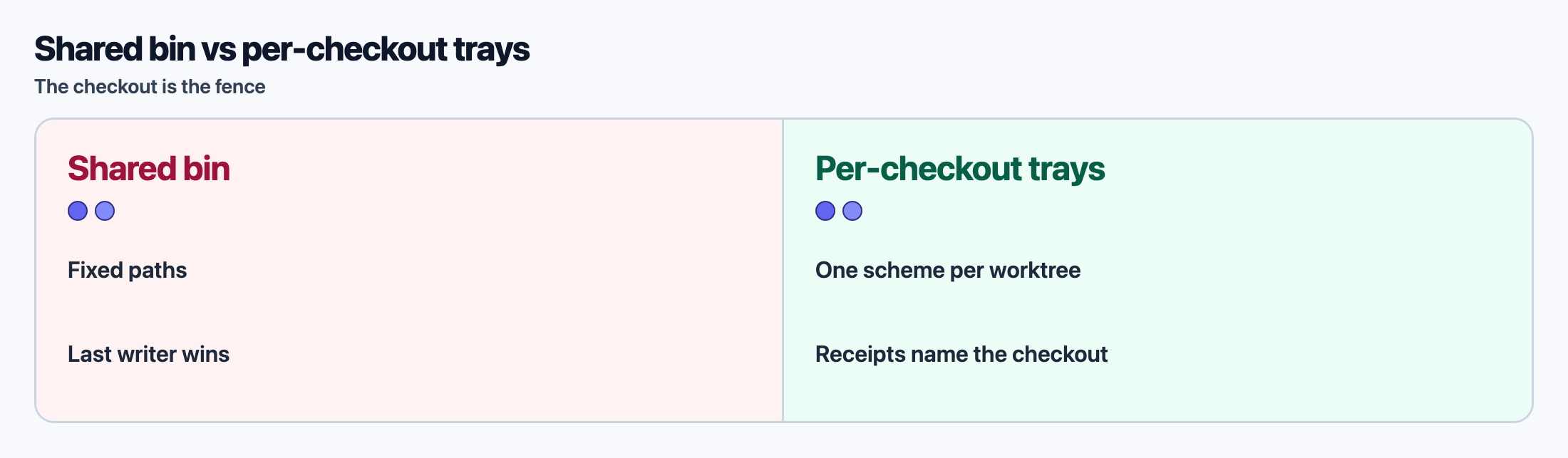
One receipt card sitting in its own teal tray with a check mark beside it, for a receipt that names its checkout

Two agents, one /tmp, and a receipt that lied

Agent A writes a prove receipt under a fixed temp name. Agent B, working on a related problem the same afternoon, overwrites it. Then a push gate reads the leftover and smiles. That is how I learned the boring way that two coding agents on the same machine will happily invent the same filenames and then argue about whose receipt is whose. I launched parallel work and watched tests and push gates read unbound or fixed scratch. “Green” was sometimes just whoever finished last painting over /tmp. ...

November 1, 2026 · Dave Voyles
Crumpled sticky note beside a real keyed lock on a steel panel

Prove the guard before it becomes the floor

Agents are fluent. Fluency is not the same as safe. If you are rolling AI agents into a real org, you already know the demo version of this problem. The model sounds careful. The slide says “guardrails.” Someone writes “do not touch production” in a prompt, and the room relaxes. That sentence is a sticky note. It is not a control. When the agent is in a hurry, or the chat got cut short, or it found a clever way to spell the same dangerous action, the sticky note is already gone. ...

October 25, 2026 · Dave Voyles
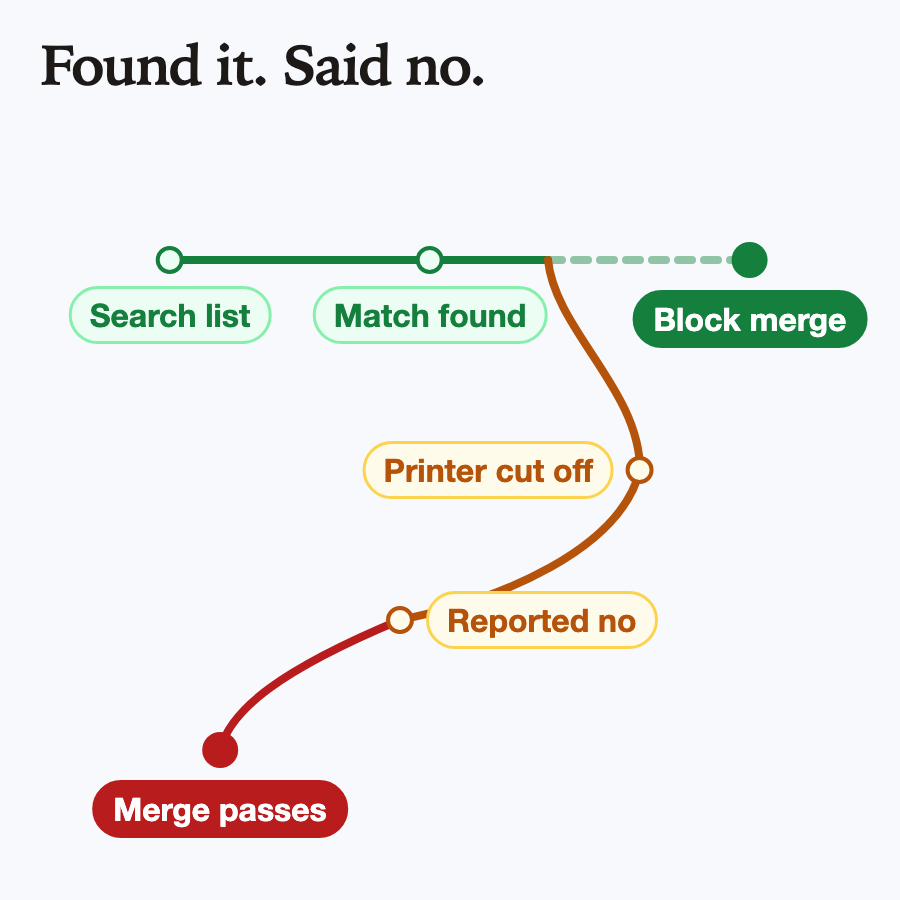
Found it. Said no. A green path labeled Search list, Match found, and Block merge. A side branch marked Printer cut off pulls the path down to Reported no, which ends at a red Merge passes.

The match that came back as no

The search found the line it was looking for. That was the annoying part. I run a handful of small safety checks around my coding agents, and one has a simple job: if the agent that wrote a pull request tries to merge it, stop it. A pull request is a proposed change waiting for approval, and the point is that the author does not get to be the approver. Under a heavy test run, that check started getting the wrong answer. It found the agent’s own work right there in the session’s commits, then concluded the agent had written nothing, which is the one answer that lets the merge through. ...

October 22, 2026 · Dave Voyles
A tray of four round lamps: three lit green with check marks, and one dark with a dashed outline. It stands for green checks that say nothing about the test nobody scheduled.

Tests that never ran now run

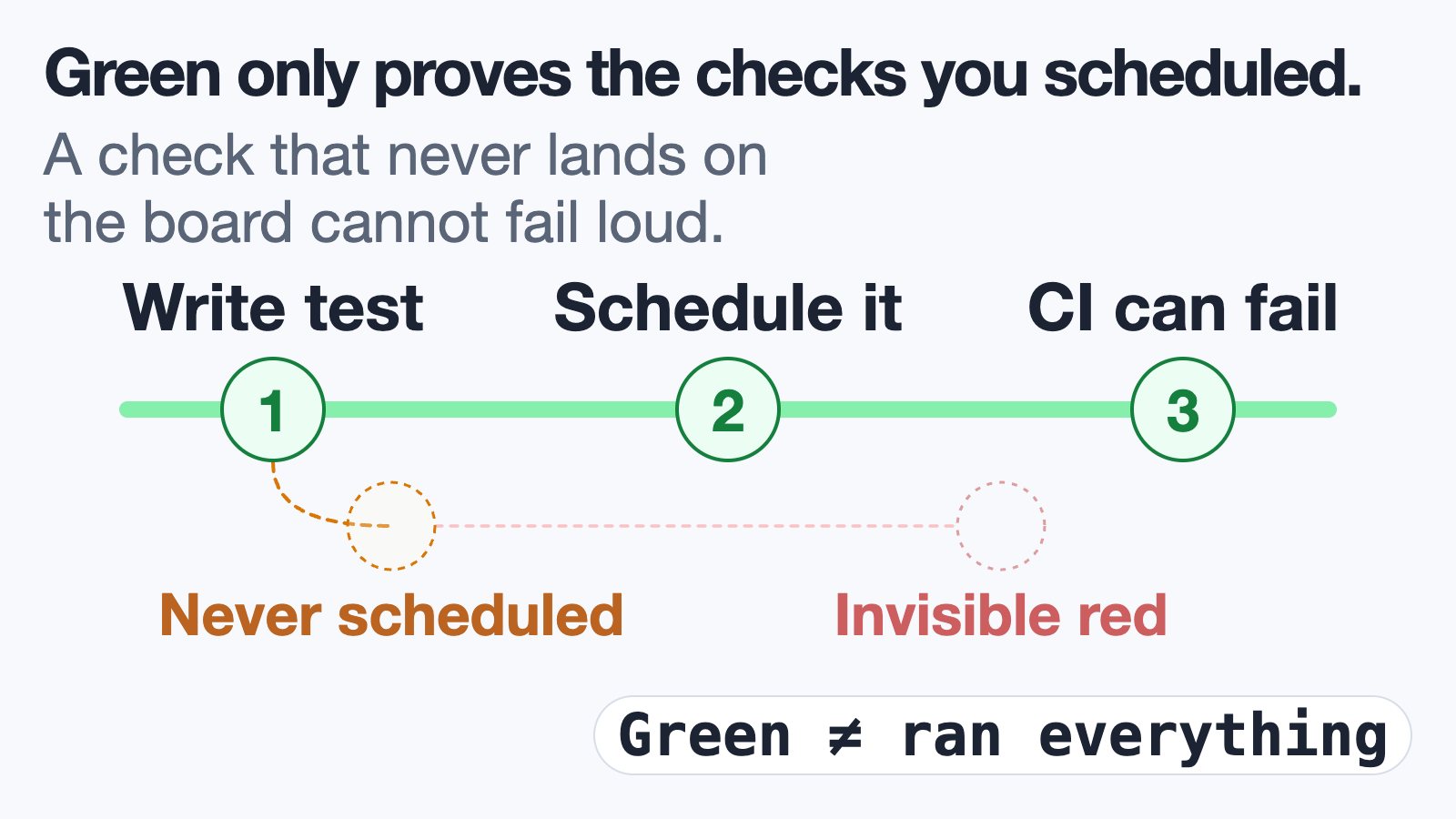
A case that checks how a scene render names its output broke on the default branch and stayed broken for about six hours, until someone ran it by hand. CI never flagged it, because the file that held that case had sat off the continuous-integration checks for a long time. The dashboard had not been asked to run that file. The rule I took from it is that green only proves the checks you scheduled. That case never ran in CI, and the failure never showed up. ...

October 19, 2026 · Dave Voyles
A bright green status panel beside an open LAN hatch the suite never checked

Green suites that hid holes: fleet gates that plant failure

I have shipped test suites that were green for the life of a repo and still left a hole on the LAN. By green I mean the dashboard color everyone treats as “safe to ship” — the check passed, the badge is cheerful, nobody is paging. CI (continuous integration) is the automated check-runner that usually paints that color: on every push or pull request it runs a suite of tests and jobs, then reports pass or fail. Green CI is valuable when it asked the hard questions. It is dangerous when it only asked the easy ones, or never ran the suite that looked like coverage. ...

September 22, 2026 · Dave Voyles
Mac Mini and NAS on a dark rack with container canisters — the homelab host layer

Twenty-plus containers and agent-operated ops

This is part 3 of the Agent production system series. Previous: Human approval. Constellation nodes: Docker host, Azure / ADO, Dashboards. Words I use below Homelab — the small, always-on computer setup in my house that runs real services for the household and for agents, not a laptop demo that dies when I close the lid Container — a boxed-up app (and its dependencies) that runs the same way on different machines; if one misbehaves, it fails in a smaller blast radius than “the whole computer” Compose — a config file that says which containers to start, how they connect, and what secrets they get, so you recreate the world from files instead of folklore OrbStack — the Docker runtime I use on the Mac Mini (think “Docker Desktop, but lighter on Apple silicon”) so containers actually run on that host Reverse proxy — one front door for many services; you hit one place instead of a pile of bookmarked :port URLs VPN gateway — a container that holds the download traffic behind a tunnel; if the tunnel drops, that traffic drops with it instead of leaking out the front door Watchtower — a helper that updates container images on a schedule, but only for services I’ve labeled as allowed to drift Agent-operated ops — agents can propose and run routine operations under the same gates as code — not root plus good intentions Those eight words are the toolkit. Now the point. ...
August 4, 2026 · Dave Voyles