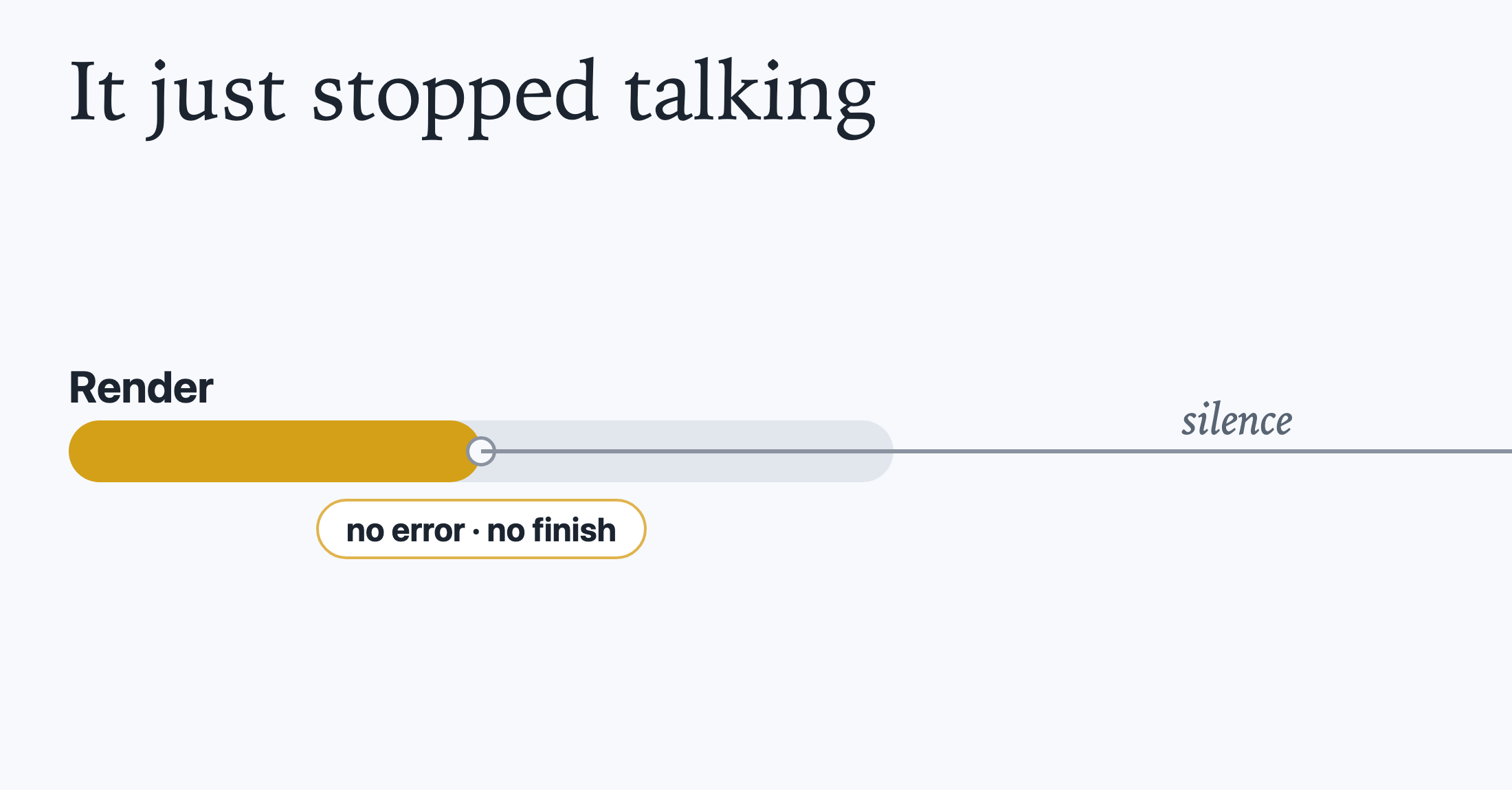
A render progress bar stops partway while a flat line labeled silence runs on off the edge, with a small tag reading no error, no finish.

One render in 25 just stopped talking

Nothing in the log said anything was wrong, and nothing on the screen moved. The render just sat there, forever, like a guest who has finished dinner and decided not to leave. I use a small film and design toolchain to make short product videos, and my coding agents do most of the work on it. Under a loop test, about one render in 25 hung like that. It gave no error and no message, and from the outside I couldn’t tell whether it was thinking hard or had quietly died in its chair. The trigger turned out to be an audio filter left without a length, which its manual says will pad silence indefinitely. Give it a length and the stalls stopped. I still don’t know why the unbounded version stalled only some of the time. That is the most annoying kind of bug there is. The rule I took from this is: every call to an outside tool needs a finish line, and when it crosses that line, it should say why. ...
November 13, 2026 · Dave Voyles
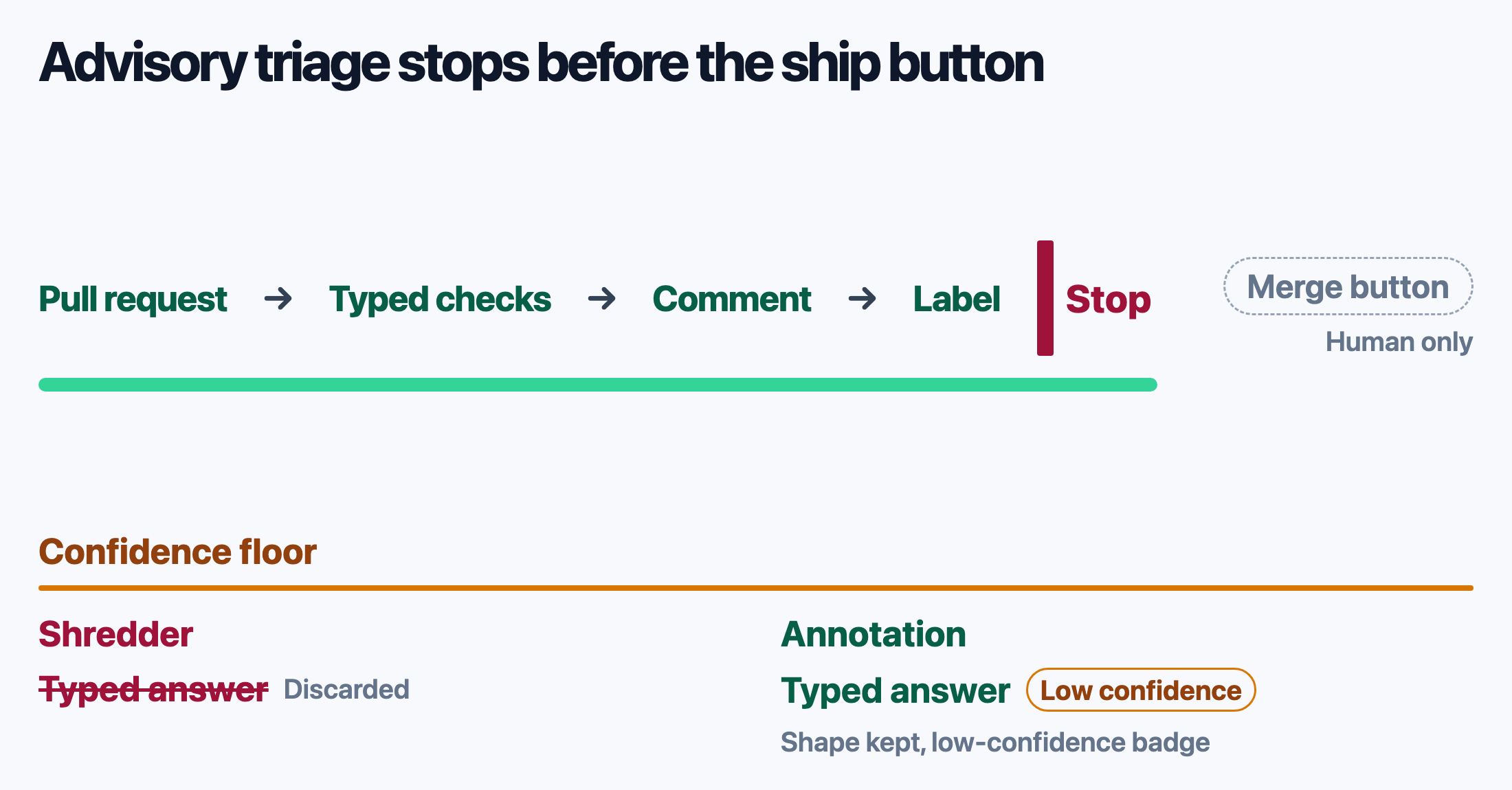
Three purple agent chips joined by a line stop at a coral bar, short of a dashed blue circle that stands for the human merge button.

My triage bot was busy and said nothing

The first time my triage bot ran for real, it did everything except the triage. It left its comment. It set its label. The checks looked calm enough that nobody panicked. Behind that, every typed answer the classifier had produced (a classifier output with a declared form, such as a named type or a score band, as opposed to free text) had been thrown away by a confidence cutoff borrowed from another classifier, so the public result read unknown. ...

November 8, 2026 · Dave Voyles
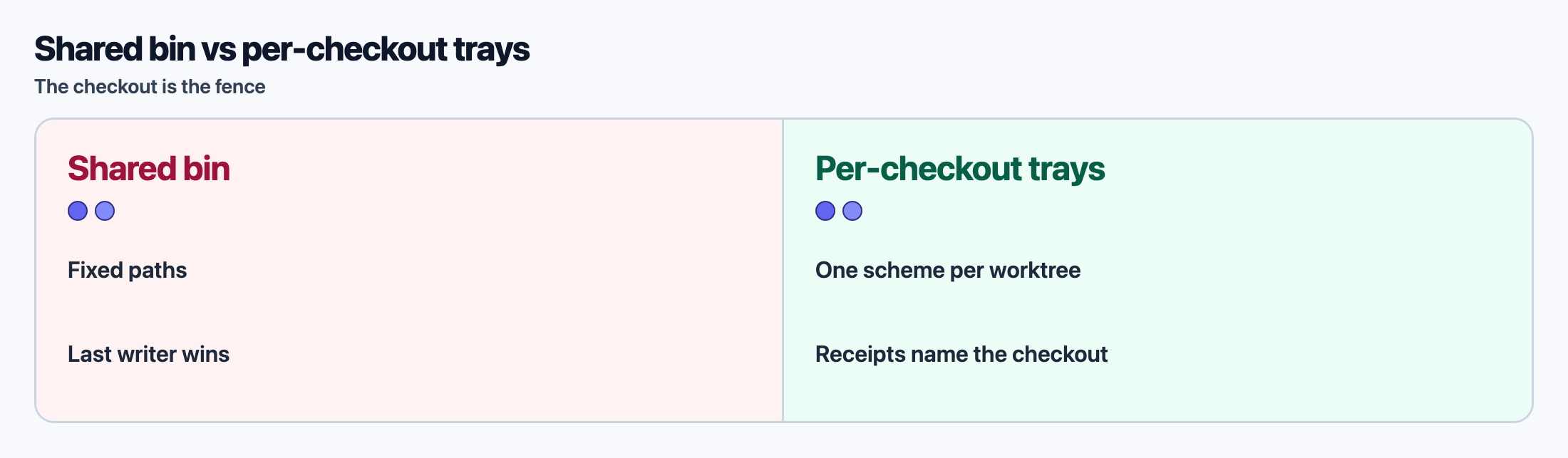
One receipt card sitting in its own teal tray with a check mark beside it, for a receipt that names its checkout

Two agents, one /tmp, and a receipt that lied

Agent A writes a prove receipt under a fixed temp name. Agent B, working on a related problem the same afternoon, overwrites it. Then a push gate reads the leftover and smiles. That is how I learned the boring way that two coding agents on the same machine will happily invent the same filenames and then argue about whose receipt is whose. I launched parallel work and watched tests and push gates read unbound or fixed scratch. “Green” was sometimes just whoever finished last painting over /tmp. ...

November 1, 2026 · Dave Voyles
Crumpled sticky note beside a real keyed lock on a steel panel

Prove the guard before it becomes the floor

Agents are fluent. Fluency is not the same as safe. If you are rolling AI agents into a real org, you already know the demo version of this problem. The model sounds careful. The slide says “guardrails.” Someone writes “do not touch production” in a prompt, and the room relaxes. That sentence is a sticky note. It is not a control. When the agent is in a hurry, or the chat got cut short, or it found a clever way to spell the same dangerous action, the sticky note is already gone. ...

October 25, 2026 · Dave Voyles
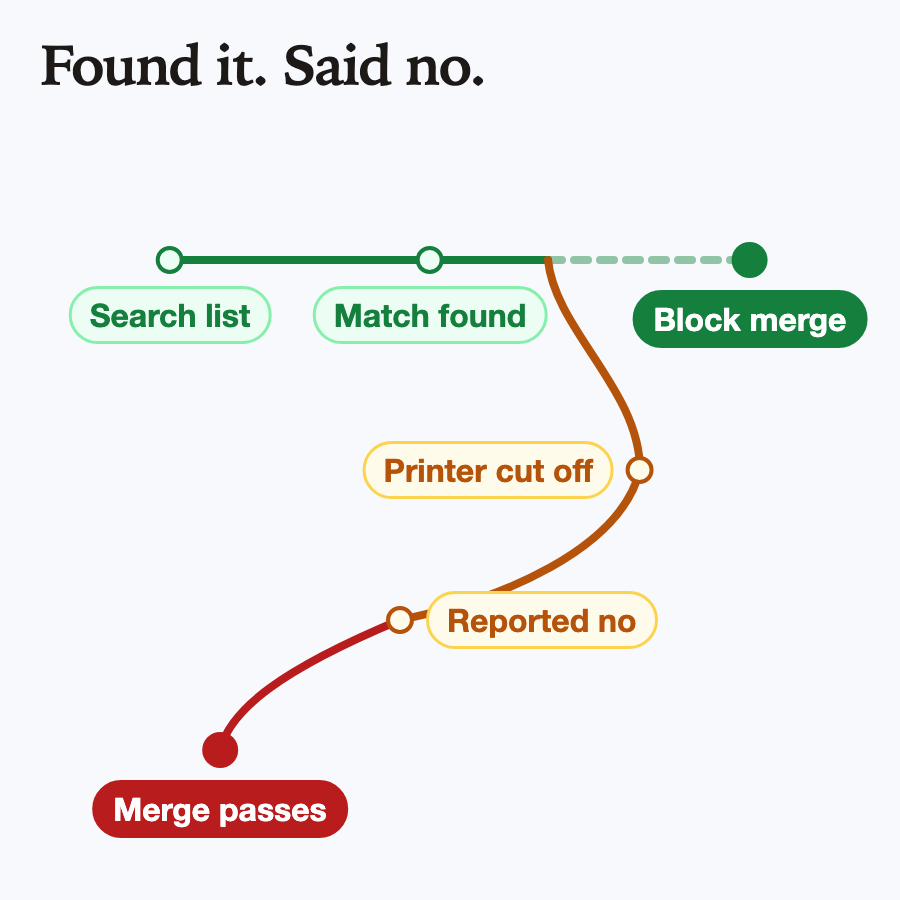
Found it. Said no. A green path labeled Search list, Match found, and Block merge. A side branch marked Printer cut off pulls the path down to Reported no, which ends at a red Merge passes.

The match that came back as no

The search found the line it was looking for. That was the annoying part. I run a handful of small safety checks around my coding agents, and one has a simple job: if the agent that wrote a pull request tries to merge it, stop it. A pull request is a proposed change waiting for approval, and the point is that the author does not get to be the approver. Under a heavy test run, that check started getting the wrong answer. It found the agent’s own work right there in the session’s commits, then concluded the agent had written nothing, which is the one answer that lets the merge through. ...

October 22, 2026 · Dave Voyles
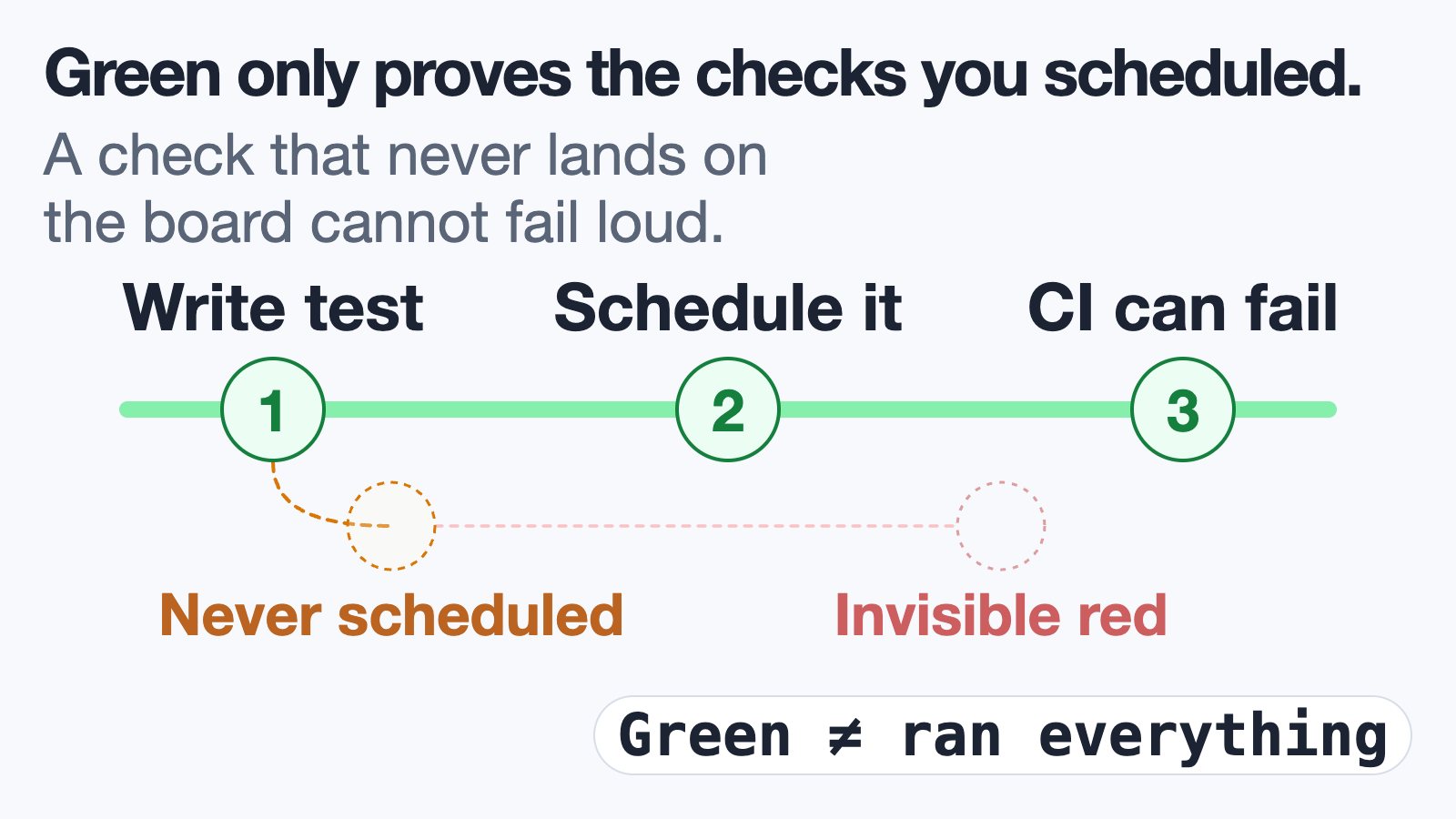
A tray of four round lamps: three lit green with check marks, and one dark with a dashed outline. It stands for green checks that say nothing about the test nobody scheduled.

Tests that never ran now run

A case that checks how a scene render names its output broke on the default branch and stayed broken for about six hours, until someone ran it by hand. CI never flagged it, because the file that held that case had sat off the continuous-integration checks for a long time. The dashboard had not been asked to run that file. The rule I took from it is that green only proves the checks you scheduled. That case never ran in CI, and the failure never showed up. ...

October 19, 2026 · Dave Voyles
Two separate computer desks — a coding laptop desk and a personal-assistant planner desk — each with its own door and a shared one-time check stamp

Two brains, two jobs: Bender engineers, Maya assists

I used to want one agent that could do everything. Write the PR, tidy the calendar, answer Slack, review the diff, remind me about lacrosse pickup — one conversational surface, one “brain,” one place to yell when something was wrong. It felt efficient until the failures started rhyming. Coding work leaned on personal-assistant shortcuts. Calendar noise interrupted engineering focus. A gateway that looked like a helpful front door became a noisy hallway where every request sounded the same, and “the agent is up” — meaning the process is running, the light is on — stopped meaning either job was actually done. ...

September 26, 2026 · Dave Voyles
A bright green status panel beside an open LAN hatch the suite never checked

Green suites that hid holes: fleet gates that plant failure

I have shipped test suites that were green for the life of a repo and still left a hole on the LAN. By green I mean the dashboard color everyone treats as “safe to ship” — the check passed, the badge is cheerful, nobody is paging. CI (continuous integration) is the automated check-runner that usually paints that color: on every push or pull request it runs a suite of tests and jobs, then reports pass or fail. Green CI is valuable when it asked the hard questions. It is dangerous when it only asked the easy ones, or never ran the suite that looked like coverage. ...

September 22, 2026 · Dave Voyles
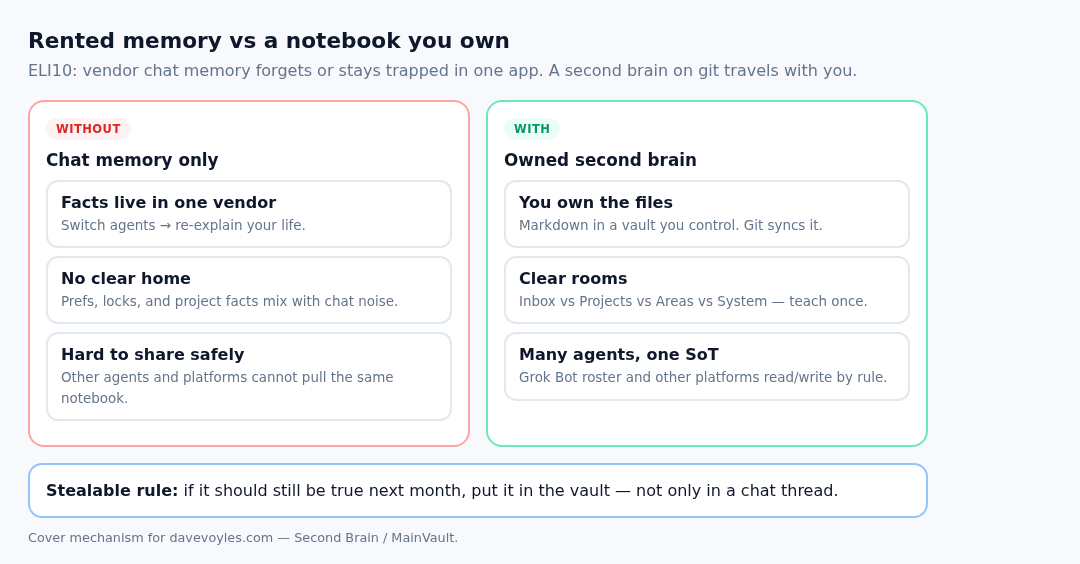
Rented chat memory versus a second brain you own

The second brain I own (and why chat memory is not enough)

Chat memory is convenient until you change apps. I run a Grok Bot roster every week — Chief of Staff, specialists, digests, drafts — and I also point other agent platforms at the same durable facts about how I work. If those facts only live inside one vendor’s chat memory, I am not building a system. I am renting amnesia with a nice UI. So I keep a second brain I own. Mine is called MainVault: a markdown vault, synced with git, treated as shared memory across agents. I already wrote the high-level “owned notebook both stacks get” frame when piloting Muse beside Grok Bot. This post is the mechanism: how that notebook works day to day. No private repo links. The point is the pattern. ...

September 16, 2026 · Dave Voyles
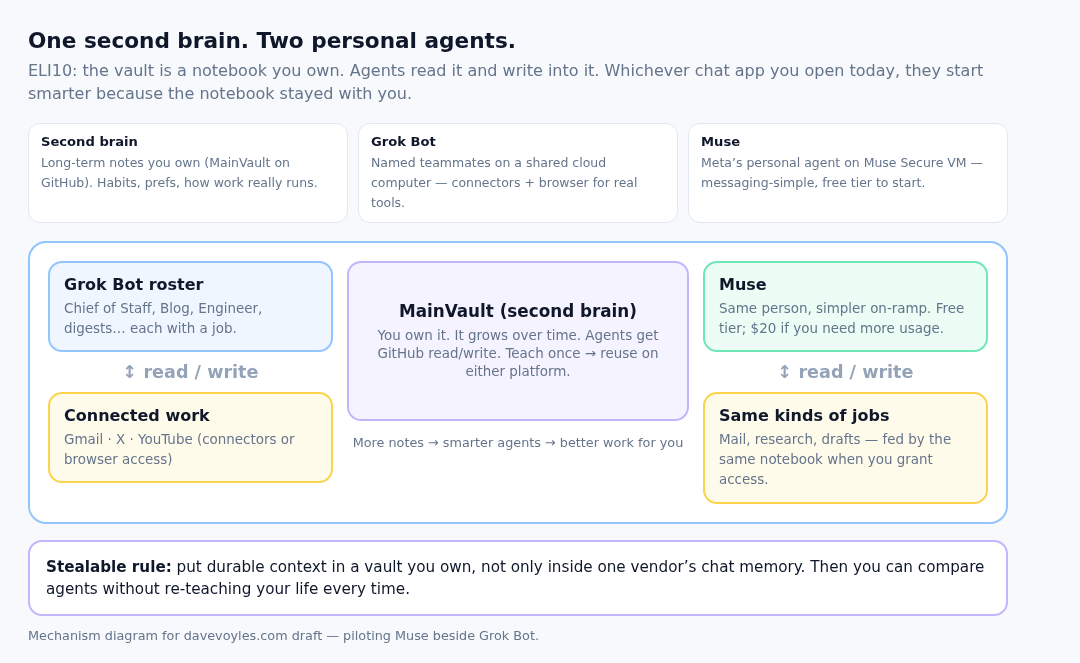
Second brain hub across Grok Bot and Muse

Piloting Muse beside Grok Bot (and why Dad started on Muse)

I am running two personal agents at once right now: Grok Bot and Meta’s new Muse. That is not a brand loyalty bit. It is a bake-off with an honest mismatch of maturity: I am piloting Muse next to a mature multi-bot Grok Bot desk I already run. This is not a feature-parity scorecard. Muse is new and simple. Grok Bot is a roster I have already wired. I want to feel where each one wins on its own terms before I pretend there is a single winner. ...

September 14, 2026 · Dave Voyles